
CATL Unveils World’s 1st Ship-Shore-Cloud System To Advance Zero-Carbon Shipping

Bulgaria Halts Rescue Of Sanctioned Tanker Hit By Ukrainian Drone Due To Stormy Weather
December 8, 2025
U.S. Defence Secretary Backs Caribbean Strike That Killed Survivors Clinging To Wreckage
December 8, 2025
Contemporary Amperex Electric Vessel (CAEV), a subsidiary of Chinese battery manufacturer CATL, has launched what it describes as the world’s first and only “ship-shore-cloud” zero-carbon shipping and integrated smart port solution at Marintec China 2025.
CAEV introduced the solution after observing that electric ships require technology built specifically for maritime conditions. CATL noted that vessels face high humidity, salt-spray exposure, long-duration routes and high power demands, making it clear that electric ships cannot simply use systems designed for land-based applications.
The company also highlighted long-standing industry challenges caused by the traditional model where power supply, energy replenishment and maintenance are managed by separate suppliers.
This, according to CATL, has often resulted in unclear accountability and coordination difficulties, slowing the development of zero-carbon shipping.
Su Yiyi, General Manager of CATL’s Electric Vessel Department and CAEV, said through the company that the lack of unified responsibility has led to persistent operational issues throughout a vessel’s 30-year service life.
Su also pointed to high upfront costs, limited energy-replenishment infrastructure, range anxiety, complex water conditions and non-standardised technology as some of the systemic problems operators face.
The newly launched Ship-Shore-Cloud model is designed as an integrated chain covering all key elements of electric-ship operation. On board, the system brings together battery systems, power systems and intelligent navigation systems to support steady, long-distance voyages.
On the shore side, CATL is promoting charging and battery-swapping facilities under a “separation of ship and battery” concept, aimed at reducing cost pressures and easing concerns over energy supply.
In the cloud, vessels are linked to the Yunfan intelligent management platform and the Beichen intelligent navigation system, enabling remote monitoring, scheduling and operational optimisation.
CATL and CAEV have already delivered nearly 900 electric ships, and the company has accumulated several industry firsts since entering the zero-carbon maritime sector.
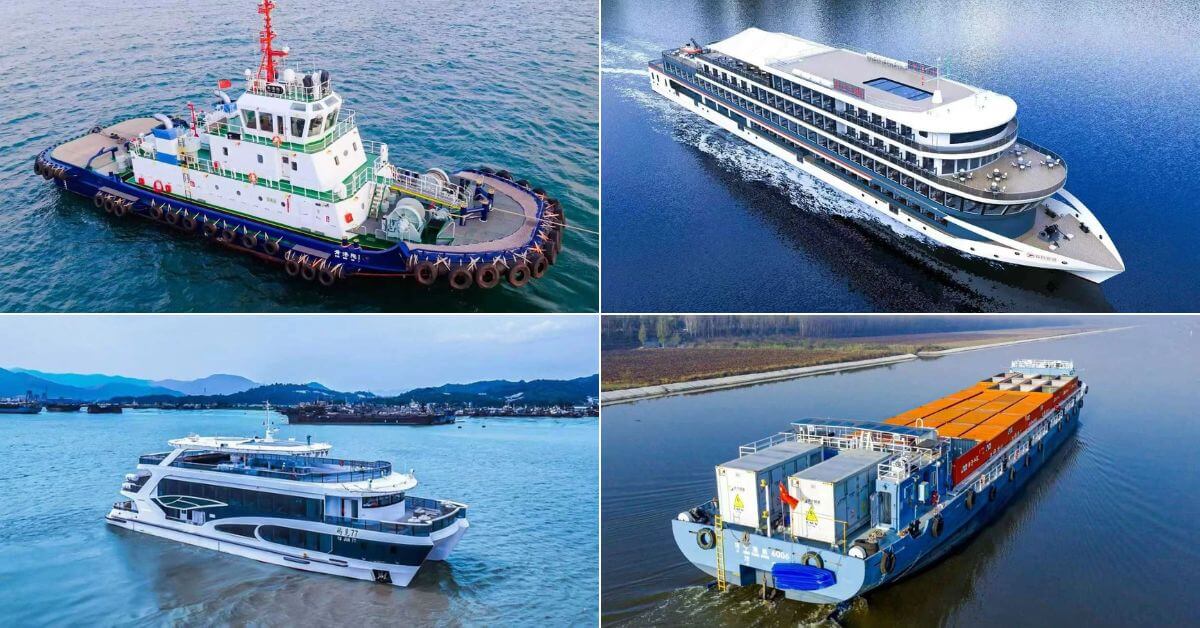
These include the world’s largest-capacity all-electric inland passenger ship Changjiangsanxia 1, China’s first all-electric sea-going passenger ship Yujian 77 classed by the China Classification Society, China’s first hybrid tug Qinggang Tug 1, and the country’s first cargo-ship battery-swapping demonstration project Jining 6006, which was delivered as a complete system and operates independently.
CATL’s battery systems, energy-management tools and related hardware and software have also received approval from the world’s five major ship classification societies.
CATL said the Ship-Shore-Cloud solution is intended to offer a full-chain approach to maritime electrification, linking vessels, shore facilities and cloud platforms in a single system aimed at supporting the expansion of zero-carbon waterborne transport.
Reference: chargedevs
Source: Maritime Shipping News