

India Notifies Guidelines INR 44,700 Cr Shipbuilding Assistance And Development Schemes

America’s Oldest Active Aircraft Carrier USS Nimitz Enters Final Retirement Planning Phase
December 29, 2025
Japan To Grant USD 22M To Egypt For Building First-Of-Its-Kind Dive Support Vessel For Suez Canal
December 29, 2025

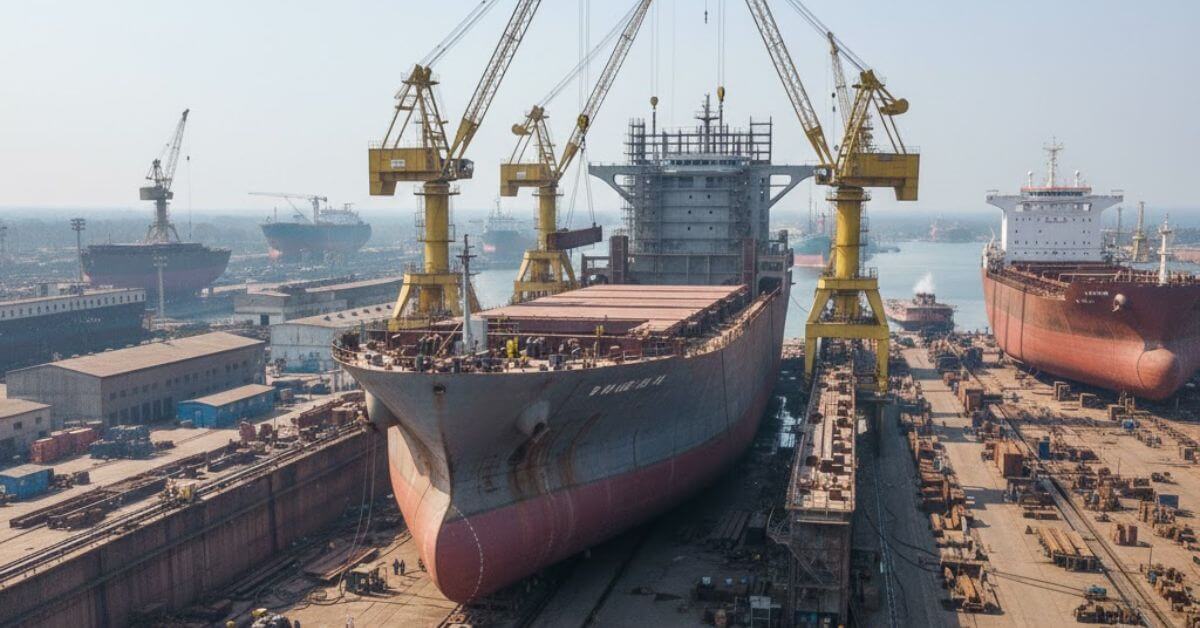
The Indian government has notified the operational guidelines for two major shipbuilding initiatives aimed at strengthening the country’s domestic shipbuilding capacity and improving global competitiveness.
The schemes, the Shipbuilding Financial Assistance Scheme (SBFAS) and the Shipbuilding Development Scheme (SbDS), carry a combined financial outlay of ₹44,725 crore.
The Ministry of Ports, Shipping & Waterways (MoPSW) said the newly approved guidelines provide a transparent and accountable framework for the implementation of the schemes, covering financial support, infrastructure development, technology advancement and risk mitigation within the shipbuilding sector.
Under the Shipbuilding Financial Assistance Scheme, which has been allocated a corpus of ₹24,736 crore, the government will provide financial assistance ranging from 15% to 25% of the vessel contract value.
The level of assistance will depend on the category of the vessel, with graded support for small normal, large normal and specialised vessels.
The scheme also includes incentives for series orders and mandates independent valuation and milestone-based assessments to strengthen governance and ensure efficient utilisation of public funds.
As part of the initiative, the government has provided for the establishment of a National Shipbuilding Mission to ensure coordinated planning and execution of shipbuilding programmes.
A Shipbreaking Credit Note mechanism has also been introduced, under which ship owners scrapping vessels at Indian yards will receive a credit equivalent to 40% of the scrap value.
These credits can be used towards new ship construction, linking ship recycling with shipbuilding and supporting a circular economy approach.
According to the ministry, the SBFAS is expected to support shipbuilding projects worth approximately ₹96,000 crore over the next decade, stimulating domestic manufacturing and generating employment across the maritime value chain.
The second initiative, the Shipbuilding Development Scheme, has a budgetary outlay of ₹19,989 crore and focuses on long-term capacity and capability creation.
The scheme provides support for the development of greenfield shipbuilding clusters, the expansion and modernisation of existing brownfield shipyards, and the establishment of an India Ship Technology Centre under the Indian Maritime University to support research, design, innovation and skills development.
Under SbDS, greenfield shipbuilding clusters will receive 100% capital support for common maritime and internal infrastructure through a special purpose vehicle formed on a 50:50 basis between the Centre and the State.
Existing shipyards will be eligible for 25% capital assistance for brownfield expansion of critical infrastructure such as dry docks, shiplifts, fabrication facilities and automation systems. All disbursements will be released in phases and monitored by independent evaluation agencies.
The scheme also includes a Credit Risk Coverage Framework, which will provide government-backed insurance for pre-shipment, post-shipment and vendor-default risks.
Speaking on the notification of the guidelines, Union Minister of Ports, Shipping & Waterways Sarbananda Sonowal said the policy framework is a significant shift in approach towards India’s shipbuilding sector.
He stated that the initiatives are intended to revive domestic shipbuilding, strengthen forward and backward industrial linkages under the Make in India programme, attract large-scale investment and build world-class maritime capacity aligned with the vision of Viksit Bharat and Atmanirbhar Bharat.
The minister said that strengthening shipbuilding and maritime capabilities would support India’s growth by promoting self-reliance, skills and global competitiveness.
The ministry said that with modern infrastructure and a skilled workforce, India’s commercial shipbuilding capacity is expected to reach about 4.5 million gross tonnes per year by 2047.
Both the Shipbuilding Financial Assistance Scheme and the Shipbuilding Development Scheme will remain in force until 31 March 2036, with an in-principle extension planned up to 2047.
The government said the schemes are expected to create jobs, support indigenous technology development and strengthen India’s maritime security and economic resilience.
Reference: PIB
Source: Maritime Shipping News