

China Conducts First Confirmed Sea Launch Of YJ-20 Hypersonic Missile From Type 055 Destroyer

Two Tankers Disentangled Off Istanbul After Anchor Chain Incident Caused By Strong Winds
December 31, 2025
Sanctioned Oil Tankers Continue Sailing To Venezuela Despite US Blockade
December 31, 2025
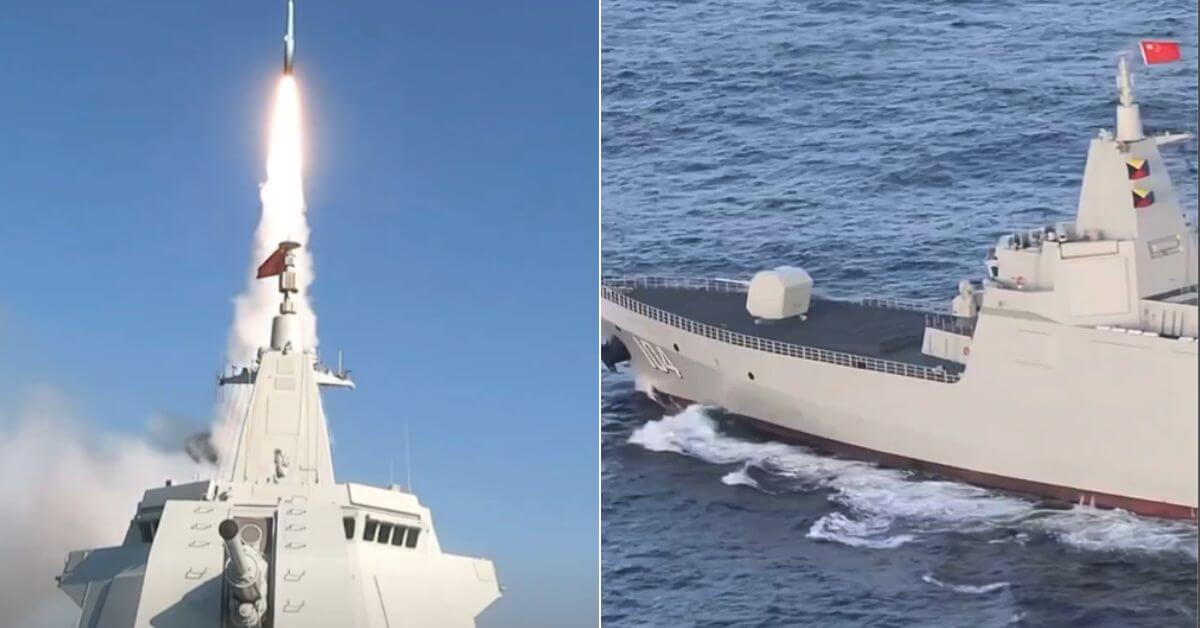
China has carried out its first officially confirmed sea launch of the YJ-20 hypersonic anti-ship ballistic missile from a surface warship.
Chinese state media reported that the missile was fired from the Type 055 guided-missile destroyer Wuxi during a final-stage trial at sea.
The report said the missile successfully hit and destroyed a maritime target at an undisclosed distance, indicating that the weapon has reached the last phase of testing before production and service entry.
The launch was carried out from a vertical launch system cell located at the aft section of the Wuxi.
According to the official explanation, the missile used a cold-launch technique, in which it is ejected from the launcher before its engine ignites, reducing stress and risk to the ship.
Video of the trial was released by China Military Bugle, an official account linked to the PLA News Media Centre.
The footage showed the missile being launched from several angles and marked the first time a Chinese state media outlet has shown a live firing of the YJ-20 from a naval vessel.
PLAN Navy releases footage of the YJ-20 Hypersonic AShM fired from a Type 055 Destroyer, proving
China’s Hypersonic mossile weapon is already equipped and ready to strike.
The YJ-20 has a 1500km range and a MACH 10 speed, 2 is enough to mission-kill the
Ford pic.twitter.com/NwRahQ52zd
— PLA Military Updates (@PLA_MilitaryUpd) December 28, 2025
The YJ-20 was first shown to the public during China’s 2025 military parade, where it appeared alongside other long-range anti-ship missile systems.
Defence analysts have previously assessed that the missile’s design suggests it can be launched from the vertical launch systems fitted to China’s modern destroyers.
According to military analysts cited in defence reporting, the YJ-20 is believed to be a hypersonic boost-glide missile capable of travelling at speeds above Mach 5.
Chinese military experts have described the weapon as using a rocket booster and a biconical glide vehicle, allowing it to manoeuvre during flight and making it harder to intercept.
Once deployed across the People’s Liberation Army Navy’s destroyer fleet, the missile is expected to give Chinese surface warships a long-range strike capability at sea.
Analysts have stated that this could allow China to threaten opposing naval forces across large parts of the Indo-Pacific region.
Observers tracking Chinese military developments have said that the missile’s reported ability to manoeuvre during re-entry makes it more difficult for current missile defence systems to counter.
They have also assessed that the YJ-20 could have a range of between 1,500 and 2,000 kilometres, enabling Chinese warships to conduct layered strikes far from home waters.
However, analysts have also pointed out that effective use of such long-range hypersonic weapons depends on advanced surveillance, targeting, and command systems.
The Type 055 destroyers are among the most powerful surface combatants in the Asia-Pacific region. Each ship displaces around 10,000 tonnes and is fitted with 112 vertical launch system cells.
China’s domestically developed VLS can fire both hot- and cold-launched missiles, including the HHQ-9 air-defence missile and the YJ-18 anti-ship cruise missile. This launch system is used on both the Type 055 and Type 052D destroyer classes.
China plans to operate a total of 16 Type 055 destroyers in the PLA Navy.
The destroyer Wuxi entered operational service in 2023 after completing its testing and acceptance trials. It was later assigned to the North Sea Fleet, strengthening China’s naval presence in the Yellow Sea under the Northern Theatre Command.
According to Chinese military sources, recent trials involving the Wuxi lasted three days and included simulated missions covering air and missile defence, attacks against surface and submarine targets, and operations in complex electromagnetic environments.
The YJ-20 joins China’s growing group of anti-ship ballistic missiles, which includes the DF-21D and DF-26. Chinese military sources have previously promoted these systems as capable of targeting aircraft carriers and distant military facilities.
Additionally, the U.S. Department of Defence has recently disclosed the existence of the DF-27, described as China’s first intercontinental anti-ship ballistic missile.
Reference: USNI
Source: Maritime Shipping News