
Pearl Harbor To House U.S Navy’s First Hypersonic-Armed Fleet By 2030

U.S Navy Veterans Develop Crewless & Captainless Warship With Impressive Range
January 16, 2026
China Overtakes Russia & Becomes World’s 2nd Biggest Operator of Nuclear Submarines
January 16, 2026
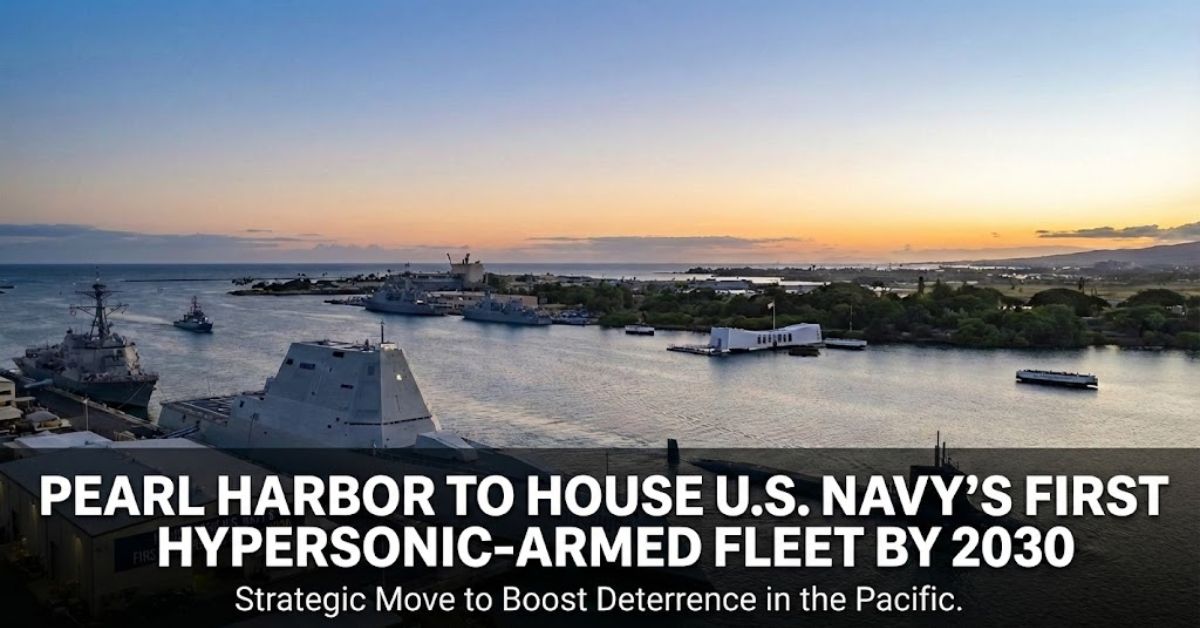
The U.S Navy is sending its warships and submarines to Hawaii, a move that will make Pearl Harbour the home of the Navy’s first hypersonic-armed surface undersea fleet by 2030.
This move is in response to the growing Chinese presence in the Pacific region.
The deployed vessels will be equipped with the Conventional Prompt Strike (CPS) weapon, the Navy’s first sea-launched hypersonic missile.
U.S Navy wants to reduce response time and boost deterrence by placing these assets near contested waters close to Taiwan and the South China Sea, said to be one of the most volatile regions on earth.
The Navy is improving its capacity to respond efficiently and in less time by homeporting these ships in Hawaii.
It plans to keep all 3 Zumwalt-class destroyers and Virginia-class submarines at Joint Base Pearl Harbor-Hickam, which is being upgraded to accommodate the advanced vessels and the new systems.
Every destroyer will have 12 hypersonic missiles, and the new Virginia-class submarines with the Virginia Payload Module will also carry the same number, providing long-range strike options across air, land and maritime domains.
Most of the modernisation work at Pearl Harbor will be completed by 2028, and the complement of ships and submarines will be at the site by the end of the decade.
The navy’s destroyers, built for shore bombardment and stealth operations, will then be able to function as hypersonic strike platforms.
The electricity generation capacity on each vessel will be massive, given the requirement to fire lasers or railguns.
A naval engineer said that the Zumwalts have the space and capacity to integrate the weapons of tomorrow and are the ideal ships for the mission.
Though the gun systems designed initially were proving to be too costly, the ship’s massive launch cells and design make them suitable for CPS integration.
Retired Rear Adm. Joe Sestak, a former carrier strike group commander, stated that nobody can defend against those hypersonic missiles; however, he also pointed out that just having 12 per ship might not be enough to stop an invasion.
The Navy might just have 60 such missiles in Hawaii by 2030, just a fraction of what might be needed in a massive conflict.
Sestak said that CPS could play a major role in 2 scenarios: a Chinese blockade of Taiwan or a full-scale amphibious invasion.
Other countries are also developing weapons, with Japan working on a ship-mounted railgun and Israel’s Rafael and Lockheed Martin making a maritime variant of the Iron Beam Laser System.
The deployment of powerful naval assets in Hawaii shows a wider U.S effort to harden its Pacific stance, reduce response times and integrate advanced systems under the Navy’s distributed operations doctrine.
It remains to be seen if the move is enough to deter China, and it will depend not on how fast the missiles fly, but on how effectively commanders use them.
Source: Maritime Shipping News