

U.S To Get New Warships Called ‘Golden Fleet’ To Counter China’s Shipbuilding Program

U.S Navy To Build Faster, Smaller Warships To Expand Fleet Rapidly
January 19, 2026
U.S Navy To Boost Fleet Capabilities With New 1000 NM Range Autonomous Drone Boats
January 19, 2026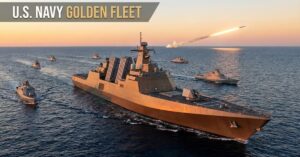
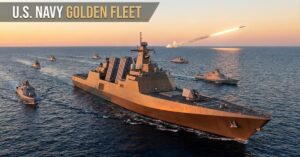

The United States will get a new class of warships called the Golden Fleet to counter China’s increasing military presence and long-range missile capabilities.
This program signals Washington’s attempt to reimagine the naval fleet around bigger, longer-range, missile-heavy vessels with small unmanned corvette-style craft to support them.
This is also a part branding move, as President Trump has time and again expressed dissatisfaction with how the current naval ships look and envisages something more visually appealing.
The ships would weigh between 15,000 and 20,000 tons, making them bigger than present-day destroyers and closer to the size of cruisers.
They will have heavy armament, including long-range missiles and hypersonic missiles. Some vessels will have advanced Propulsion systems, automated systems, integrated sensors, and modular combat systems.
The navy is also planning to build small support ships like corvettes, frigates and unmanned platforms to support the bigger warships for a more distributed and agile warfare.
The goal is to build a distributed, resilient, long-range strike fleet instead of a conventional carrier-centric one.
However, U.S shipyards are maxed out building Columbia-class subs and Ford-class carriers.
Additionally, the hypersonic missile tech is not yet ready for production on a large scale, and then there are cost issues with new designs costing between four and six billion dollars per ship.
It is expected that the U.S Congress will approve the funds for the program by 2027. The U.S may partner with allies to secure some of the smaller variants for its fleet.
The U.S is pushing hard to increase the number of hulls to overpower China, which is the world leader in the number of ships.
With currently available capacity and resources, the U.S cannot build more destroyers or large ships, hence it has rethought its fleet composition and come up with a distributed warfare strategy.
The earliest prototype can be expected only in the 2030’s as Congress would take time to authorise the designs and costs.
Source: Maritime Shipping News