
China To Build World’s First Nuclear-Powered Container Ship

U.S Company To Build Autonomous Wind Powered Vessel With Foldable Wings
January 20, 2026
U.S Navy Hastens To Deploy Unmanned Surface Vessels, 3 USV Divisions To Be Created Next Week
January 20, 2026
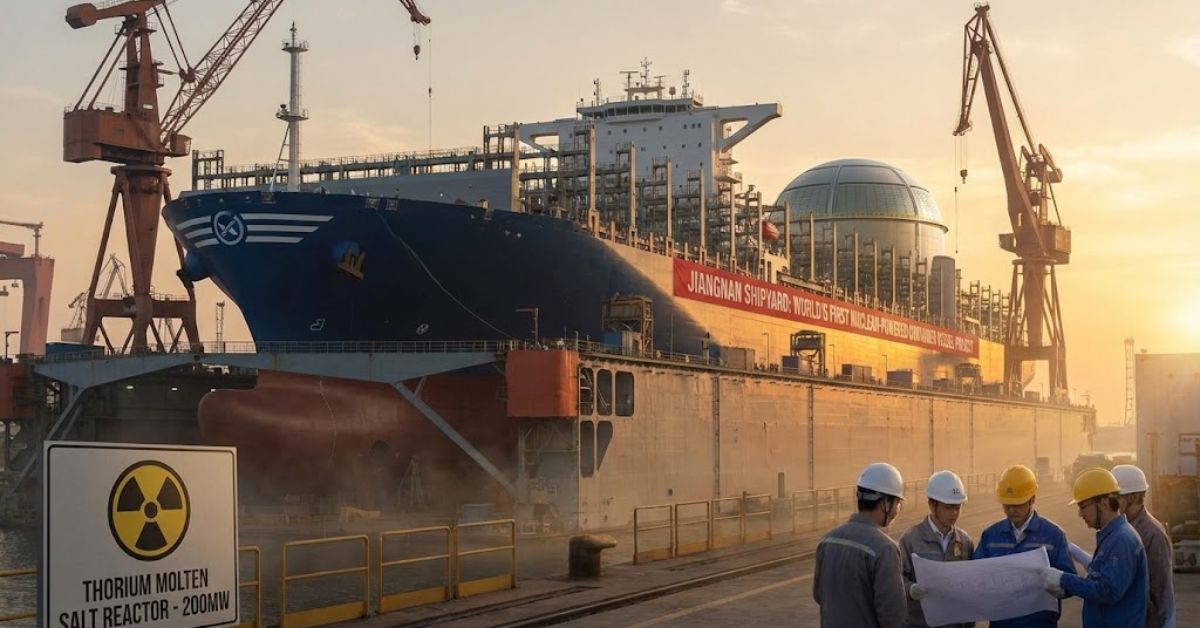
The Chinese government-owned Jiangnan Shipyard is building a 25,000 container nuclear-powered ship.
It would be a world-first for nuclear propulsion to be used for a container vessel, though it has been used in aircraft carriers and submarines.
This project, if successful, would drastically impact commercial shipping, which is struggling to reduce greenhouse gas emissions and adopt greener technologies and fuels.
Per sources, construction of the ship could begin in a decade, and Jiangnan is also planning to invest in specialised facilities for building more such nuclear vessels for commercial use, though China has not revealed the cost of such shipyards.
It would be a fourth-generation nuclear system, and the ship would be powered by a thorium-based molten salt nuclear reactor with a 200-megawatt output and a 40 year operational time span.
Many support this endeavour, citing benefits like zero emissions, long range, no need for refuelling, lower costs of operations, high speeds, etc.
However, regulatory concerns remain, and only the future will tell which government body will approve its construction and operation, as large-scale deployment remains uncertain.
The announcement came amidst China’s shipbuilding sector facing increasing geopolitical and market pressures.
In the first 9 months of 2025, China’s shipyards recorded 65% of the world’s shipbuilding orders by deadweight tonnage, a reduction from 2024’s 75% in the same period.
Fresh orders for Chinese-built ships have reduced significantly in the past few months.
Additionally, US President Trump has announced plans to overthrow China’s dominance in shipbuilding by proposing a plan to revive the US shipbuilding industry, including port infrastructure and technologies.
Against this backdrop, China State Shipbuilding Corp, Jiangnan’s parent company and the world’s largest shipbuilding conglomerate, is trying harder to speed up their industry value chains and production process.
It is redirecting focus to sectors like deep-sea drill ships, cruise ships and nuclear-powered vessels, incorporating AI and new energy technologies.
Other prominent Chinese shipping companies are also racing into clean-energy shipping.
For instance, Contemporary Amperex Technology, the manufacturer of the world’s biggest electric vehicle battery, announced its plans to construct its first battery-powered ship within 3 years.
Source: Maritime Shipping News