

China Reveals World’s First Autonomous Drone That Can Hunt & Destroy Submarines

China Tests New LY-1 Laser Weapons System On Civilian RORO Vessel
January 28, 2026
World’s First Marine Habitat Allows Scientists To Live Underwater For Days
January 28, 2026
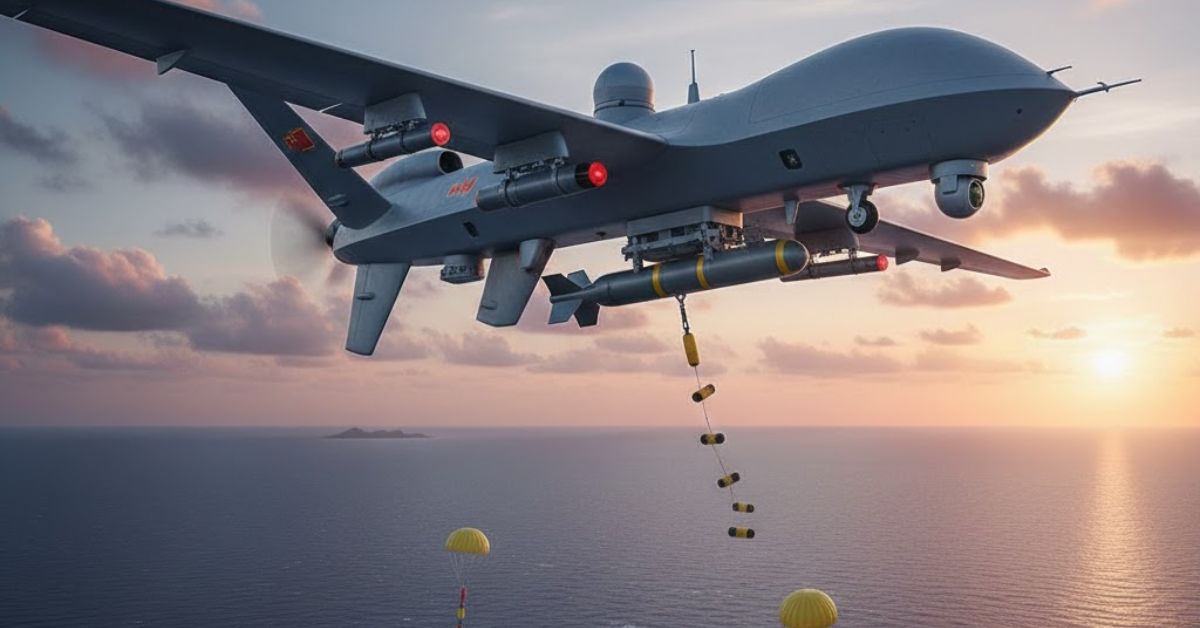
China revealed its new autonomous drone, called the Wing Loong X, at the Dubai Airshow 2025.
It is said to be the first unmanned aerial vehicle (UAV) capable of fully independent anti-submarine warfare (ASW).
The drone has a wingspan of 20 metres, approximately the size of a small business jet.
It can operate for 40 hours with a ceiling of 10,000 metres, meaning it can sit at a maritime chokepoint for almost two days at a stretch and listen for submarines.
Aircraft like America’s P-8 “Poseidons” can’t do this, given crew fatigue and cost.
Another advantage is the drone’s ability to deploy sonobuoys, which are small floating sensors that can identify submarines underwater.
Usually, only manned aircraft can drop sonobuoys, which help personnel or operators to analyse the sound captured and then send warships to engage with potential enemy submarines, if they are found.
Beijing has made many claims, boasting that its latest drone can drop sonobuoys, analyse the data using AI, identify and categorise targets and even attack timely.
It can also accommodate lightweight anti-submarine torpedoes.
If these claims are genuine, then the drone can not only find submarines but also destroy and damage them, helping China establish its control over the disputed South China Sea.
The strength of submarines is stealth, and if China can deploy 20 to 40 such drones in the air simultaneously, then enemy submarines do not have a chance against them.
The U.S and its allies would have to prepare immensely to face these new-generation drones to prevent their submarines from being detected.
The drone would also remove the need for China to construct expensive manned anti-submarine aircraft, which cost around 200 million dollars each and are manned by 10 to 12 specialists.
The new drone is easier to build, is cost-effective and can be deployed in swarms. They don’t need maintenance or repairs and are not easy to shoot down.
Though all of it sounds impressive, using AI to identify something as a submarine is controversial and difficult to accept by most experts.
Anti-submarine warfare also suffers from issues like false positives when, by mistake, whales or commercial ships are identified as threats.
This is why manned aircraft have trained personnel, and the field requires experience and expertise.
If a drone has to do this job perfectly, it has to fuse sonar, radar, infrared, and electronic intelligence to interpret patterns.
It is also vital to distinguish between real and false targets and predict the submarine route correctly.
If China has really developed what it claims, then the drone is a big achievement.
Source: Maritime Shipping News