

Mukran LNG Terminal Resumes Operations After Icebreaking Efforts Reopen Frozen Channel

Hapag-Lloyd Signs $4.2 Billion Deal To Acquire Israeli Shipping Company ZIM
February 17, 2026
Norwegian Cruise Line Holdings Orders 3 Next-Generation Cruise Ships From Fincantieri
February 17, 2026
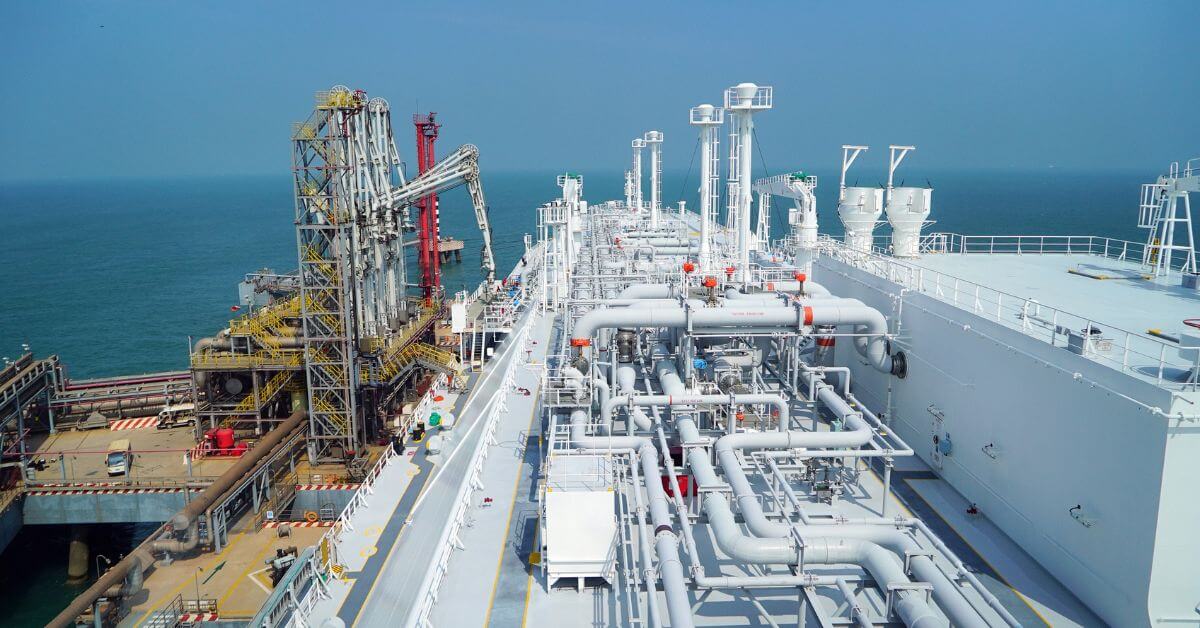
Operations at Germany’s largest floating LNG import terminal at Mukran have resumed after icebreaking efforts reopened a navigable channel through heavy sea ice in the Baltic Sea, restoring access for LNG carriers following weeks of disruption.
The approach to the terminal, located off Rügen Island in the bay of Prorer Wiek, had been blocked by dense ice, preventing vessels from safely entering or departing.
The reopening allowed the LNG carrier Maran Gas Nice (174,295 cbm) to leave Mukran on 11 February after being unable to depart since late January.
Another vessel, Minerva Amorgos (174,000 cbm), which has been waiting offshore since 3 February, is expected to be escorted into the terminal as conditions permit.
Icebreaking operations were initially led by the federal multipurpose vessel Neuwerk, which was transferred from the North Sea to the Baltic Sea to assist in clearing the channel.
The vessel, built in 1998, has a displacement of 3,000 tonnes, measures 79 metres in length, and is designed to operate in ice up to 50 centimetres thick. It has a bollard pull of 113 tonnes and an ice class of E3.
However, the Waterways and Shipping Authority (WSA) reported that Neuwerk developed a technical defect while on duty and returned to Mukran for inspection.
German broadcaster NDR indicated that one of the vessel’s engines lost power, limiting its icebreaking capability.
The ship subsequently proceeded to Rostock for further technical examination. The WSA did not disclose details of the damage or confirm when the vessel would return to service.
Following the malfunction, the chartered tug VB Bremen Fighter took over ice-clearing duties to maintain the approach channel.
The largest German Baltic Sea icebreaker, Arkona, had earlier been redeployed to the North Sea as part of the operational swap.
Satellite imagery in recent weeks showed thick ice covering the bay, with no visible open channel.
Per reports, ice thickness in some areas exceeded 30 centimetres, while wind-driven accumulation created ridges approaching one metre in places.
The heavy conditions left Minerva Amorgos waiting in an ice-free zone off Rügen for about a week.
The disruption affected gas flows into Germany’s transmission system. Mukran stopped supplying gas in early February as storage levels fell to their lowest seasonal point since 2013.
National LNG inflows declined by more than 40 per cent, from about 35 million cubic metres per day to around 20 million cubic metres per day.
Mukran operates using the LNG vessel Neptune (145,000 cbm), which Deutsche ReGas established as a floating storage and regasification unit.
The terminal has become a key element of Germany’s LNG import infrastructure developed after the loss of Russian pipeline gas supplies.
Over the past three months, the facility handled approximately 12.9 TWh of gas equivalent, including around 4.4 TWh in January. February volumes are expected to be significantly lower due to the ice-related interruption.
Authorities across the Baltic region, including Finland, Sweden and Estonia, have increased demand for icebreaker assistance this winter as navigation channels narrowed in shallow bays and coastal gulfs.
References: oilprice, ndr
Source: Maritime Shipping News