
Seaspan Invests $1.5M In Robotics To Automate Shipbuilding Blast & Paint Operations

Maritime Workers’ 48-Hour Strike Over Labour Bill Disrupts Grain Shipments In Argentina
February 19, 2026
German Researchers Commence €390,000 Project To Reduce Cavitation Noise From Ships
February 19, 2026
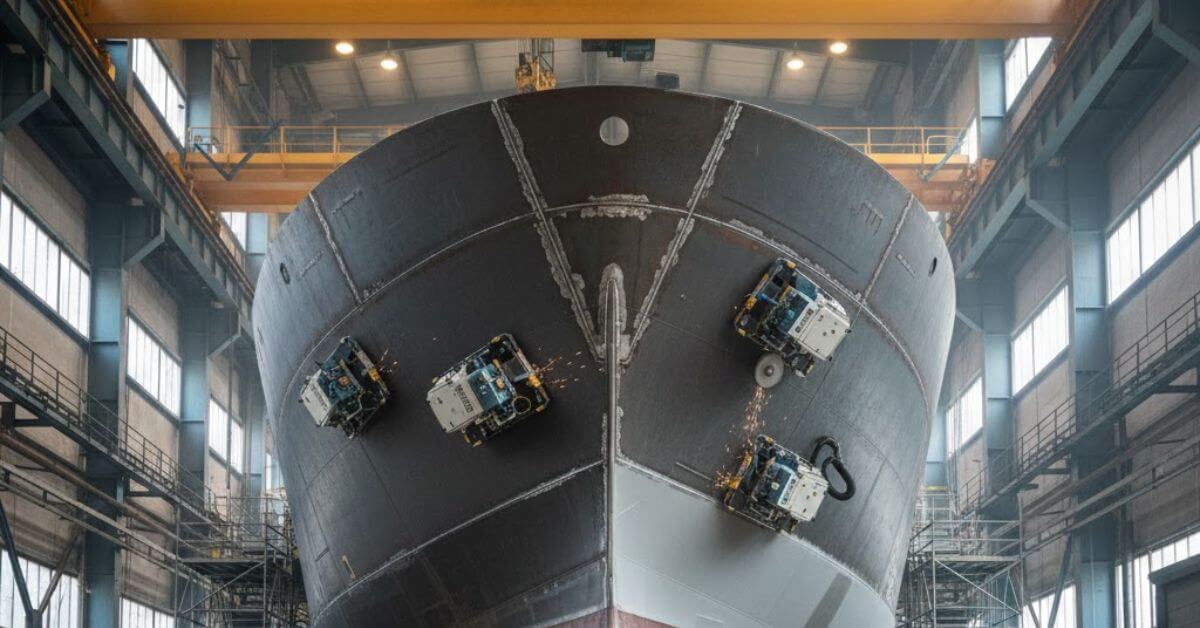
Vancouver-based Seaspan Shipyards has awarded a $1.5 million contract to Alberta’s Confined Space Robotics (CSR) to develop semiautonomous robotic systems for blast and paint operations across its ship and submarine programmes.
The investment, announced on 12 February, is aimed at improving safety, efficiency and quality in one of the most demanding areas of ship construction and maintenance.
The robotic platforms will be equipped with specialised tools, including needle scalers, laser ablation systems, grinders, grit blasters and spray-coating equipment.
Custom-developed software will manage path planning and operational control, enabling the systems to function inside confined and high-risk spaces where workers are typically exposed to toxic fumes, particulates and repetitive strain.
Blast and paint work is used in new shipbuilding as well as in complex submarine projects, ship repair and overhaul.
Seaspan said the initiative is intended to make these operations safer, more efficient and higher quality across its business.
By assigning repetitive surface preparation and coating tasks to robotic systems, the company aims to reduce worker exposure to hazardous environments and long-term strain injuries while improving consistency in application.
CSR will use Canadian expertise and components to develop several products for collaborative robot systems.
The equipment will be mounted on mobility platforms designed for manual manoeuvring and integrated with software that controls movement and user operations.
According to CSR’s Director of Engineering and Projects, Ahmed Kawar, the partnership is focused on advancing robotic technology in shipbuilding while improving workplace safety and allowing skilled personnel to concentrate on higher-value work.
Seaspan’s Senior Vice President of Strategy, Business Development and Communications, Dave Hargreaves, said the contract is part of the company’s Value Proposition commitment under Canada’s National Shipbuilding Strategy.
He stated that the strategy is intended to build a sustainable and high-functioning shipbuilding ecosystem and said that the partnership would extend Seaspan’s supply chain into Alberta while supporting safety and sustainability objectives.
Seaspan employs around 5,000 workers at its facilities in North Vancouver and Victoria. The company is constructing vessels for the Royal Canadian Navy and the Canadian Coast Guard, having delivered four ships to date, with three more currently under construction under a long-term programme of up to 23 vessels.
Reference: Seaspan
Source: Maritime Shipping News