

Indian Navy Likely To Commission Third Indigenous Nuclear-Powered Submarine “INS Aridhaman”

AI Technology To Help Cut Planning Time By 50% And Optimise Vehicle Loading On Car Carriers
February 20, 2026
Environmental Groups Urge IMO To Reject Toxic At-Sea Ammonia Discharge From Ships
February 20, 2026
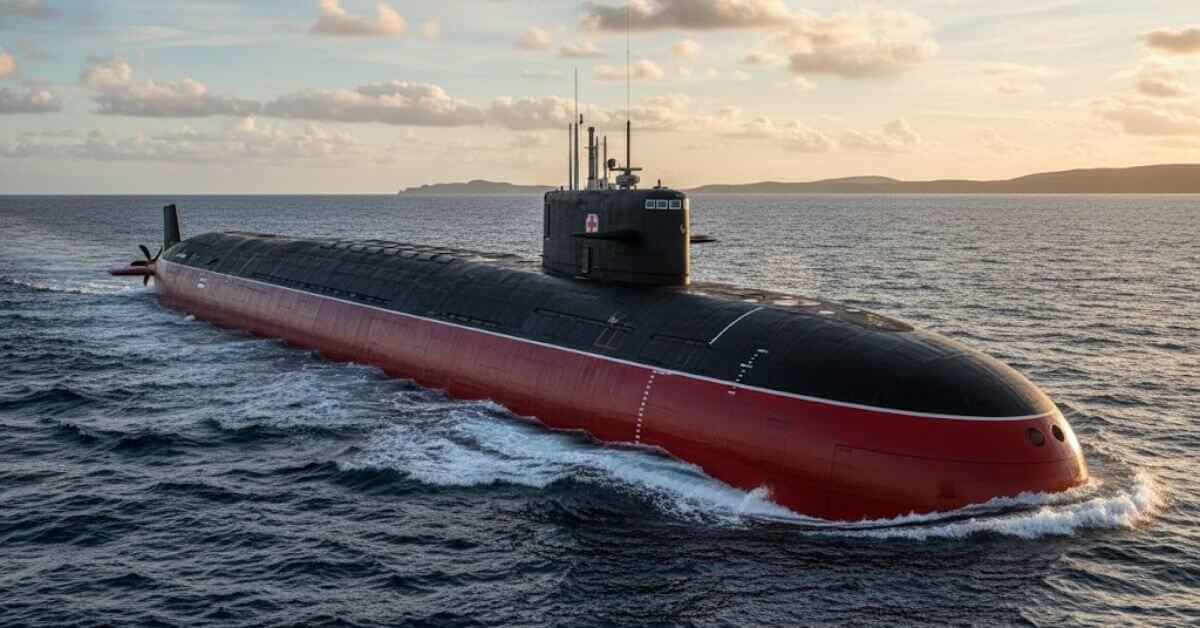
India is expected to commission its third indigenous nuclear-powered ballistic missile submarine (SSBN), INS Aridhaman (S4), by April or May.
The submarine is currently in the final stages of sea trials and is likely to enter service in the coming months.
The induction of INS Aridhaman will mark the first time India has three operational SSBNs under the Strategic Forces Command (SFC).
This development moves the country closer to achieving Continuous At-Sea Deterrence, a posture that ensures at least one ballistic missile submarine remains on patrol throughout the year.
INS Aridhaman is the third vessel in the Arihant-class and has been built under the Advanced Technology Vessel (ATV) project at the Ship Building Centre in Visakhapatnam.
At approximately 7,000 tonnes, it is larger than its predecessors, INS Arihant and INS Arighaat, which each displace around 6,000 tonnes.
The submarine is equipped to carry 24 K-15 Sagarika submarine-launched ballistic missiles (SLBMs) with a range of 750 km and eight K-4 SLBMs with a range of 3,500 km.
The K-4 missiles are capable of striking targets across most parts of Asia. The vessel is powered by an 83 MW pressurised water reactor.
Officials have previously indicated that Aridhaman is undergoing final trials before commissioning.
In December last year, Navy Chief Admiral Dinesh K Tripathi had stated that the submarine would be inducted into service during the current year.
India commissioned its second indigenous SSBN, INS Arighaat, at Visakhapatnam in August 2024.
The first vessel of the class, INS Arihant, was commissioned around ten years ago and completed its first deterrence patrol in 2018.
The fourth submarine in the series, codenamed S-4*, is expected to enter service in 2027.
INS Aridhaman is fitted with indigenous USHUS and Panchendriya sonar systems, advanced sonar suites, and improved acoustic damping supported by anechoic tiles to reduce detectability.
Once commissioned, it will be based at Project Varsha, a high-security naval facility with underground pens near Visakhapatnam.
The Indian Navy is securing an Akula-class nuclear-powered attack submarine (SSN) from Russia, commonly referred to as Chakra III, with delivery expected by 2027 or early 2028.
India and Germany are also in advanced negotiations on the $8–10 billion Project-75(I) programme, which aims to construct six conventional diesel-electric submarines equipped with Air-Independent Propulsion (AIP) systems.
The submarine acquisitions come as Pakistan is buying eight Hangor-class diesel-electric attack submarines from China under a $5 billion deal signed in 2015.
References: Firstpost, hindustantimes
Source: Maritime Shipping News