
China Achieves Historic Autonomous Docking With Smart Container Ship ‘Zhi Fei’ At Qingdao Port

Watch: Salvage Crews Move Grounded Barge 30 Feet In High-Tide Refloat Attempt Off Puerto Rico
February 24, 2026
EU Extends Operation ASPIDES Until 2027, Allocates €15 Million To Protect Red Sea Shipping
February 24, 2026
China has completed its first full-process unmanned container ship operation, covering autonomous navigation, berthing and cargo handling at Qingdao Port in Shandong Province on February 21.
The smart feeder vessel Zhi Fei docked, secured, and handled containers without manual intervention.
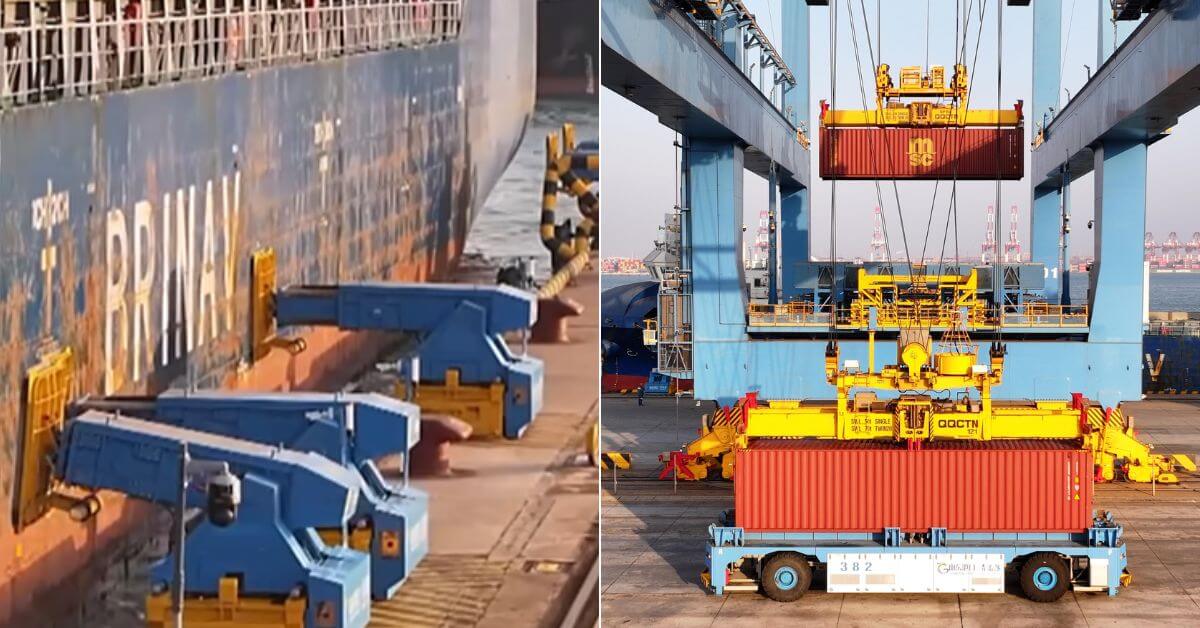
The vessel docked at an automated terminal at Qingdao Port, where it completed a fully autonomous berthing procedure.
After positioning alongside the berth, a vacuum-based automatic mooring system secured the vessel in less than 30 seconds.
The system uses suction pads that attach directly to the hull, eliminating the need for traditional mooring lines and manual line handling.
Terminal operations then began under the coordination of a domestically developed terminal operating system (A-TOS) and equipment control system (A-ECS).
These systems directed quay cranes and automated guided vehicles with millisecond-level response times to complete loading and unloading tasks.
The berth itself supports autonomous container handling through automated cranes and trucks.
The vessel, named Zhi Fei (meaning “intelligent navigation”), is China’s first smart container ship to enter commercial service.
It is operated by Navigation Brilliance (BRINAV). The 300 TEU feeder ship measures approximately 110 meters in length and entered commercial service in April 2022.
Video Credits: CGTN/You Tube
The ship supports three operating modes:
- Manual control
- Remote control from a shore station
- Fully autonomous navigation
It operates between Qingdao Port and Dongjiakou, covering a longest single journey distance of 89 nautical miles at speeds up to 12 knots.
According to BRINAV, the vessel completed 353 voyages last year, transporting more than 80,800 TEU.
Since entering service, it has traveled over 48,000 nautical miles and its onboard systems have made more than one million independent decisions.
BRINAV reports that the ship operates with 30 percent fewer crew members compared to a conventional feeder vessel.
The company estimates that the system reduces the risk of human error by 80 percent. Monthly operating costs are reduced by approximately $27,500.
Jiang Haiying, chairman of Navigation Brilliance, told Chinese media that intelligent shipping is intended to make operations safer and more efficient, rather than simply replace human roles.
Autonomous vessel technology has been under development for years in countries such as Norway and Japan, but large-scale commercial operations remain limited.
Reference: CGTN
Source: Maritime Shipping News