
Shipping Giant Maersk Suspends All Vessel Transits Through Strait Of Hormuz After Ship Attacks

Two Oil Tankers Hit By Missiles Near Persian Gulf Amidst Deteriorating Security Situation In The Gulf
March 2, 2026
Unknown Projectiles Strike Ships Near Oman And UAE, UKMTO Issues Urgent Strait Of Hormuz Warning
March 2, 2026
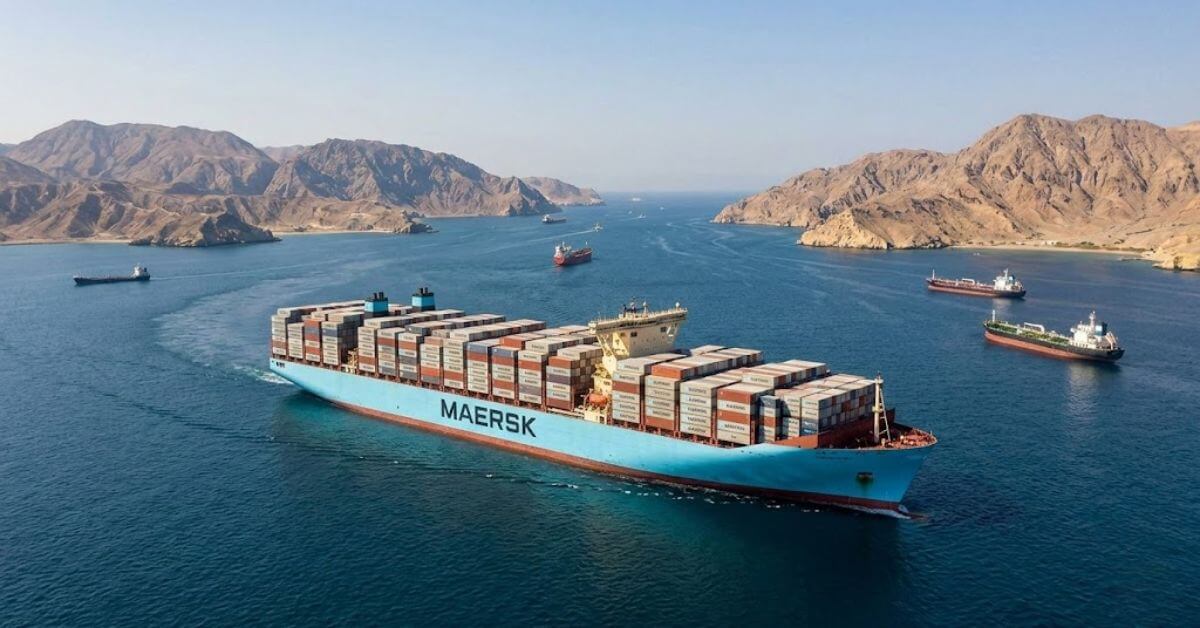
Global container shipping giant A.P. Moller-Maersk has suspended all vessel crossings through the Strait of Hormuz following attacks on ships in the region and escalating tensions between the United States and Iran.
The Danish company said it paused operations due to safety concerns. It warned that services linked to Gulf ports may face delays and rerouting.
The advisory was issued on Sunday after Iran’s Revolutionary Guards declared the strait closed and multiple vessels reported security incidents near the mouth of the Persian Gulf.
Maersk confirmed it is suspending all vessel crossings in the Strait of Hormuz until further notice. The company stated that the safety of crews, vessels and customer cargo remains its priority.
The company also said it would pause future Trans-Suez sailings through the Bab el-Mandeb Strait.
Ships operating on Middle East–India to Mediterranean and Middle East–India to U.S. East Coast services will now be rerouted around the Cape of Good Hope at the southern tip of Africa.
The diversion adds thousands of nautical miles to voyages between Asia, the Middle East and Europe. Longer routes typically increase transit time, fuel costs and freight rates.
Maersk also announced the closure of its offices in the United Arab Emirates, Qatar and Oman. The suspension follows confirmed attacks on vessels operating near the Strait of Hormuz.
The United Kingdom Maritime Trade Operations (UKMTO) Centre reported that one ship off the coast of the United Arab Emirates was struck by an unknown projectile, causing a fire.
Oman’s state media said an oil tanker off its coast was targeted, leaving four crew members injured. The incidents occurred near the entrance to the Persian Gulf, just north and south of Oman.
Maritime sources reported that multiple vessels received VHF radio warnings from Iran’s Revolutionary Guards stating that no ship was allowed to pass through the strait.
An official from the European Union naval mission Aspides said such transmissions were made to ships in the area.
The British Navy stated that Iran’s orders were not legally binding but advised vessels to transit with caution. Maersk is not alone in taking precautionary action.
German container carrier Hapag-Lloyd suspended all vessel transits through the Strait of Hormuz until further notice. Mediterranean Shipping Company (MSC) instructed its vessels in the Gulf to proceed to designated safe shelter areas.
France’s CMA CGM advised its ships to take shelter and also suspended passage through the Suez Canal.
Shipbroker Poten & Partners said vessel traffic through the Strait of Hormuz has not completely stopped but disruptions are increasing rapidly.
The tanker association INTERTANKO reported that the U.S. Navy warned against navigation across the Gulf, Gulf of Oman, North Arabian Sea and the Strait of Hormuz, stating it could not guarantee safe passage.
Greece’s shipping ministry advised vessels to avoid the Persian Gulf, the Gulf of Oman and the Strait of Hormuz.
The Strait of Hormuz handles roughly 20% of global oil flows. Supplies from Saudi Arabia, the United Arab Emirates, Iraq, Kuwait and Iran transit through the waterway. Large volumes of liquefied natural gas (LNG) from Qatar also pass through the strait.
Consultancy Kpler reported that 14 LNG tankers slowed, turned back or stopped in or around the Strait of Hormuz. The firm warned that disruptions could increase and potentially threaten Qatari LNG exports.
The strait is about 50 kilometres wide at its narrowest point and is no deeper than 60 metres in some areas. It connects the Persian Gulf to the Indian Ocean and lies between Iran and Oman’s Musandam exclave.
Given its geography, the waterway is vulnerable to military escalation or blockades.
The suspension of Hormuz transits affects container trade, tanker operations and LNG shipments. Rerouting vessels around the Cape of Good Hope increases sailing distance significantly, raising bunker consumption and voyage duration.
Longer routes can disrupt schedules across Asia-Europe and Middle East trades. Port congestion may also rise if multiple services adjust rotations simultaneously.
Energy markets remain sensitive to any disruption in Hormuz. Even partial slowdowns can impact oil prices, LNG deliveries and regional supply chains.
The International Maritime Organization urged shipping companies to exercise maximum caution and avoid the affected region where possible until conditions improve.
References: LiveMint, businesstoday
Source: Maritime Shipping News