

U.S Strikes Iranian Navy In Operation Epic Fury, Warships Hit At Bandar Abbas And Chah Bahar

Video: Belgium Seizes Sanctioned Russian ‘Shadow Fleet’ Tanker Ethera In North Sea Operation
March 2, 2026
Global Container Major Hapag-Lloyd Suspends Strait Of Hormuz Transits Amid Middle East Conflict
March 2, 2026
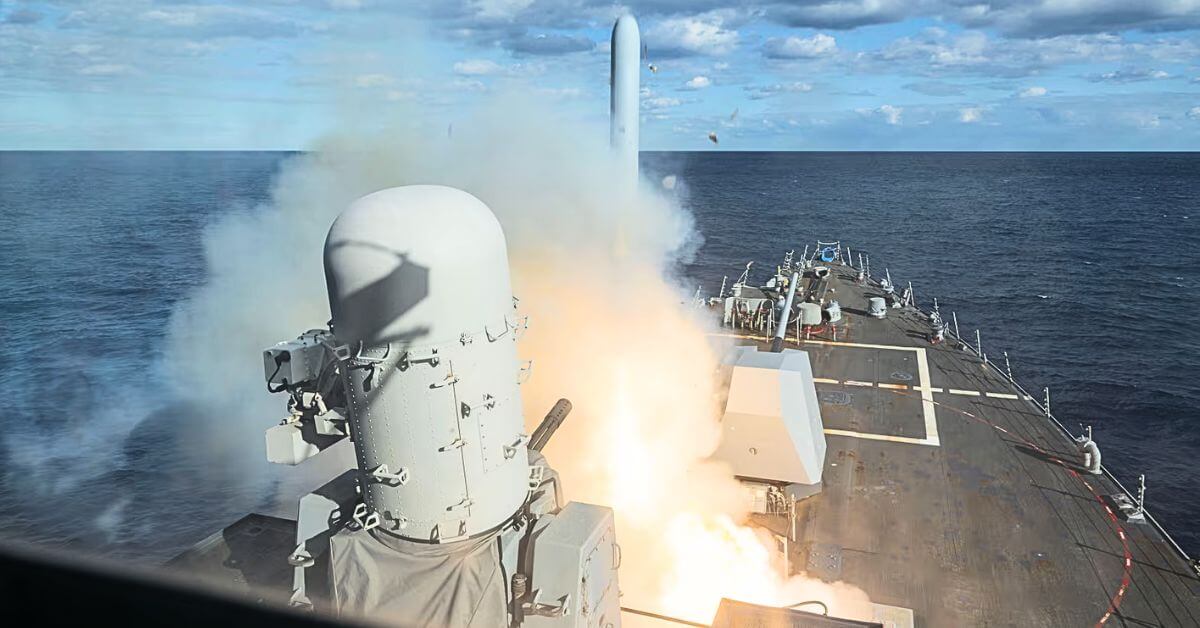
The United States and partner forces launched Operation Epic Fury on February 28, striking Iranian military infrastructure, including naval facilities at Bandar Abbas and near Chah Bahar.
Satellite imagery and official statements indicate that at least one Iranian warship was hit, while multiple naval assets were reportedly damaged.
United States Central Command (CENTCOM) announced on March 1 that U.S. forces struck an Iranian Jamaran-class vessel during the opening phase of the operation.
According to the command, the ship was hit while moored at a pier in Chah Bahar and was reportedly sinking in the Gulf of Oman.
The vessel has been identified by analysts as either the Moudge-class frigate IRINS Jamaran (F76) or the Bayandor-class corvette IRINS Naghdi (F82).
The operation began at 1:15 a.m. ET on February 28 and targeted Islamic Revolutionary Guard Corps (IRGC) command centers, air defense systems, missile and drone launch sites, and military airfields.
CENTCOM stated that U.S. and partner forces also defended against hundreds of Iranian missile and drone launches in the initial hours.
No U.S. casualties were reported, and damage to U.S. installations was described as minimal.
Satellite imagery from February 28 showed smoke rising from the naval wharf at the Konarak Naval Base near Chah Bahar, which serves Iran’s 3rd Naval District.
A warship appeared partially submerged alongside the pier, with debris scattered across the dock area.
The Iranian Islamic Revolutionary Guard Corps (IRGC) killed more than 1,000 Americans over the past 47 years. Yesterday, a large-scale U.S. strike cut off the head of the snake. America has the most powerful military on earth, and the IRGC no longer has a headquarters. pic.twitter.com/WdpN7JBECr
— U.S. Central Command (@CENTCOM) March 1, 2026
Two Kaman-class fast attack craft were visible nearby and appeared intact. Per reports, the adjacent Chah Bahar airbase, known as 10 Tactical Air Base (10TAB), was struck. Hardened aircraft shelters used to store anti-ship drones were said to have been hit.
At Iran’s main naval hub in Bandar Abbas, several major warships were present in port in the days leading up to the strikes.
On February 25, the frigates IRINS Sabalan (F73), Sahand (F74), Jamaran (F76) and Zagros (H313) were reportedly alongside in the naval harbor.
Also in the inner harbor were two Kilo-class submarines, IRINS Taregh (S901), believed to be semi-operational, and IRINS Nooh (S902), undergoing deep refit in dry dock. The status of IRINS Yunes (S903), the third Kilo-class submarine, remains unclear.
An IRGC Navy catamaran corvette, likely IRIS Shahid Nazeri, was moored in its usual position in the western basin.
Two converted oil tanker drone carriers, IRIS Shahid Mahdavi (C110-3) and IRIS Shahid Bagheri (C110-4), were anchored approximately 4 nautical miles south of the naval harbor in the Bandar Abbas roads.
Per initial reports, Iran’s oil loading terminal on Kharg Island may have been targeted. If confirmed, this would represent a direct strike on strategic energy export infrastructure.
The Strait of Hormuz, one of the world’s most critical maritime chokepoints, quickly saw changes in ship traffic. Late on February 28, outbound traffic through the eastbound channel of the Traffic Separation Scheme remained heavy, with ships exiting the Gulf.
However, by March 1, outbound movements had declined sharply, and inbound traffic was minimal.
Operation Epic Fury represents one of the largest concentrations of American military force in the region in recent years.
U.S. President Donald Trump stated publicly that the operation would “annihilate” Iran’s navy, though it remains unclear whether the primary focus is the regular Iranian Navy (Nedaja) or the IRGC Navy (Nedsa), which has been linked to threats against commercial shipping in the Strait of Hormuz.
References: US Centcom, kursiv
Source: Maritime Shipping News