
Unified Command Ends Major Cleanup After Historic Tug Dominion Sinks In Bremerton

Video: Fire Breaks Out After Explosions Hit Two Russian-Sanctioned Tankers Off Turkey
November 29, 2025
Ukrainian Man Suspected Of Damaging Nord Stream Pipelines Placed Under Custody In Germany
November 29, 2025
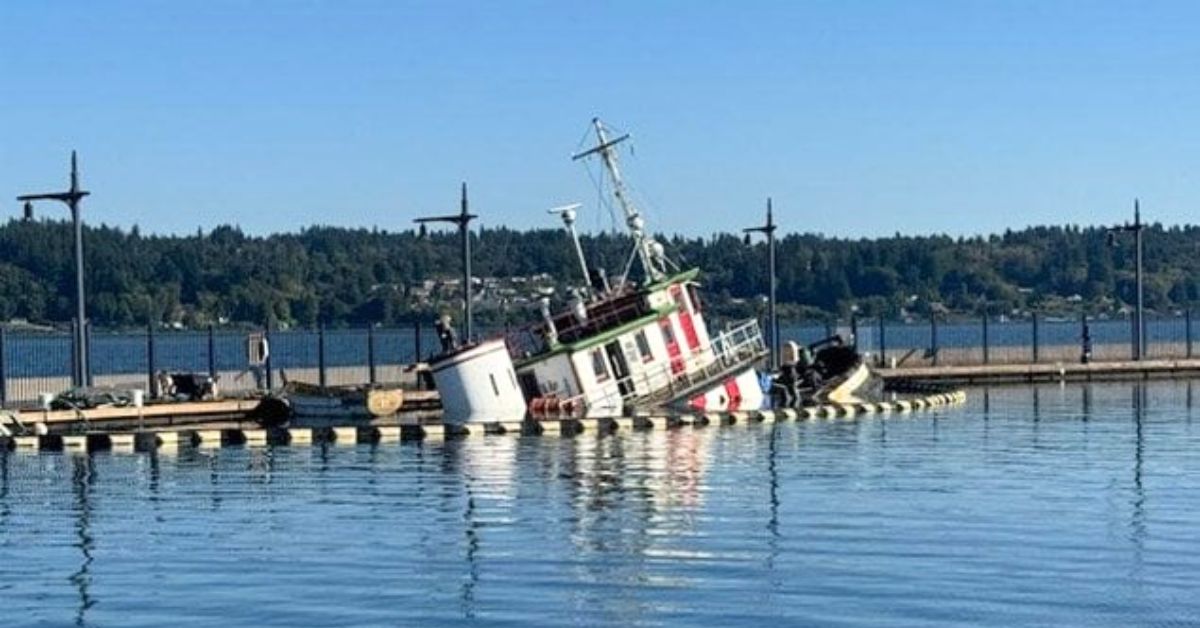
The Unified Command involving the U.S. Coast Guard, Washington Department of Ecology, the Suquamish Tribe, and the Port of Bremerton has formally ended its response to the sinking of the historic tug Dominion at the Bremerton Marina.
The 130-foot World War II-era vessel went down on 17 September, prompting a major pollution-control and salvage operation that has now been completed.
The wooden-hulled tug, built in 1944 for the U.S. Navy, had served under various owners and remained a well-known local vessel.
After it sank, the Washington Department of Ecology oversaw two attempts to refloat the tug. During the second attempt, responders found the hull so structurally compromised that even multiple dewatering pumps were unable to counter continuous flooding. The vessel was subsequently lowered back into the water.
With refloating no longer possible, the Department of Ecology reclassified the privately owned tug as “marine debris,” enabling an on-site deconstruction. Salvage teams used cranes to dismantle the vessel section by section, loading debris onto a barge for transport to a salvage yard in Seattle.
The U.S. Coast Guard opened the Oil Spill Liability Trust Fund to address pollution risks. Contractors deployed containment boom, skimmers, and absorbent materials to recover oil and safeguard nearby sensitive habitat. Shoreline assessment teams monitored surrounding areas, and the light sheen observed was deemed non-recoverable.
A debris curtain installed around the wreck successfully contained most oiled debris during the deconstruction process. Observers monitoring the water and shoreline reported that only small amounts of sheen escaped, with no recoverable oil found outside the containment area.
Authorities confirmed that crews collected 22,018 gallons of oil/water mixture, 190 tons of solid waste and debris, and 60 tons of metal. Teams also decontaminated 61 vessels within the Bremerton Marina. Contaminated materials are being transported to a hazardous waste facility in Oregon for proper disposal.
Wildlife specialists were present daily throughout the operation. No affected wildlife were observed, and there were no sightings of orcas near the response site. A limited amount of containment boom will remain in place for several days while responders remove remaining equipment.
Members of the Unified Command described the effort as a coordinated response across federal, state, local, and tribal organisations. Officials said Lt. Cmdr. Sean DiGeorge from U.S. Coast Guard Sector Puget Sound pointed to strong inter-agency cooperation in managing what was considered a significant environmental risk.
The cause of the tug’s sinking remains under investigation. Authorities said that individuals or businesses affected by the spill may be eligible for compensation through the U.S. Coast Guard’s National Pollution Funds Center.
Reference: USCG
Source: Maritime Shipping News