
MGI Engineering Launches Autonomous Electric Vessel To Cut Cost & Carbon Footprint

Washington State Ferries Selects ABB To Power Their First Hybrid-Electric Newbuild Vessels
December 2, 2025
Black Sea Shipping Costs Surge After Ukrainian Drones Hit Two Tankers
December 2, 2025
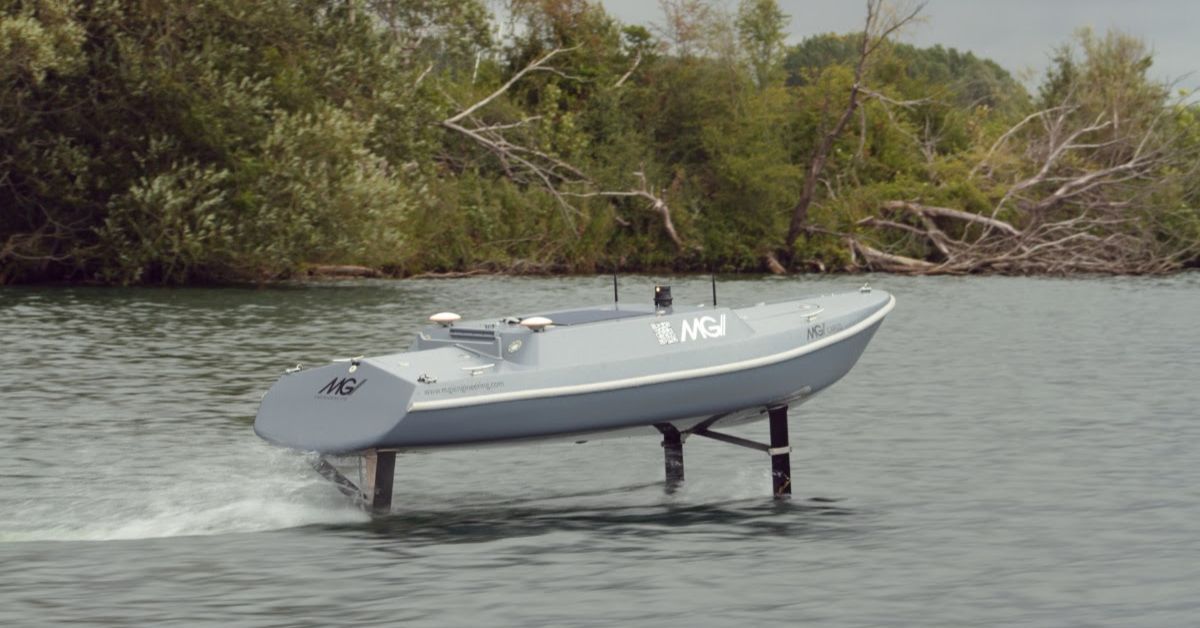
British engineering firm MGI Engineering has unveiled SeaGlide, an autonomous foiling vessel designed to cut the cost and carbon footprint of short-range maritime logistics.
The all-electric Uncrewed Surface Vehicle (USV) can carry up to 200kg of cargo for 150km all-electric at a cruise speed of 25 knots, providing an on-demand alternative to crewed launches and ferries traditionally used for inter-island and coastal deliveries.
A key feature of the system is its compatibility with MGI’s airborne Mosquito cargo UAV, allowing the creation of a fully integrated air-sea logistics network. This pairing enables parcels to be flown from inland addresses to the coast by air, transferred autonomously to SeaGlide for the maritime leg, and then delivered directly to remote islands or coastal communities without any human handling. The capability opens the door to end-to-end, zero-emission delivery networks that bridge gaps between land, sea and air infrastructure.
SeaGlide’s electric motors are mounted within its fins, lifting the hull clear of the water via fully adjustable hydrofoils to reduce drag and boost range. The near-silent propulsion and self-stabilising foils draw on MGI’s Formula One composites and control systems heritage, enabling high-speed performance and efficient operation in variable sea states.
Its BVLOS-certified (beyond-visual-line-of-sight) autonomy suite integrates AIS, radar and optical sensors with advanced collision-avoidance and precision-docking software, allowing the vessel to navigate and berth independently. A hybrid-electric variant is currently in development to extend range up to 500km for longer routes and heavier payloads.
MGI says the platform directly tackles one of the most persistent challenges in maritime logistics — the “last mile” between ports and remote communities – where high crew costs, regulatory limits and fuel dependency make traditional services inefficient and carbon intensive.
For postal operators, parts suppliers and logistics firms, these short maritime hops often represent a disproportionate share of delivery costs. For coastal and island populations, they can determine access to essential supplies such as medicine, mail and food.
“SeaGlide is a direct response to the commercial and environmental challenges in maritime logistics,” said Mike Gascoyne, MGI’s chief executive officer. “By applying our F1 experience in lightweight composites and aerodynamic efficiency to the water, we’ve created a platform that makes autonomous, zero-emission delivery commercially viable.”
SeaGlide is available in four-metre, five-metre and six-metre variants and is currently undergoing sea trials in UK waters. Operated from a single ruggedised ground station for mission planning, launch and monitoring, it is designed for scalable, low-cost fleet operations.
Designed, tested and manufactured in the UK, SeaGlide is available for international licensing and production partnerships.
Source: Maritime Shipping News