
U.S. Navy Pays $3.3 Million For Dutch LST-100 Design To Fast-Track McClung-Class Landing Ships

LPG Tanker Owner Still Unable To Reach Pirates After Abduction of 9 Seafarers In Gulf of Guinea
December 9, 2025
Austal USA Lays Keel For First Heritage-Class Offshore Patrol Cutter For U.S. Coast Guard
December 10, 2025
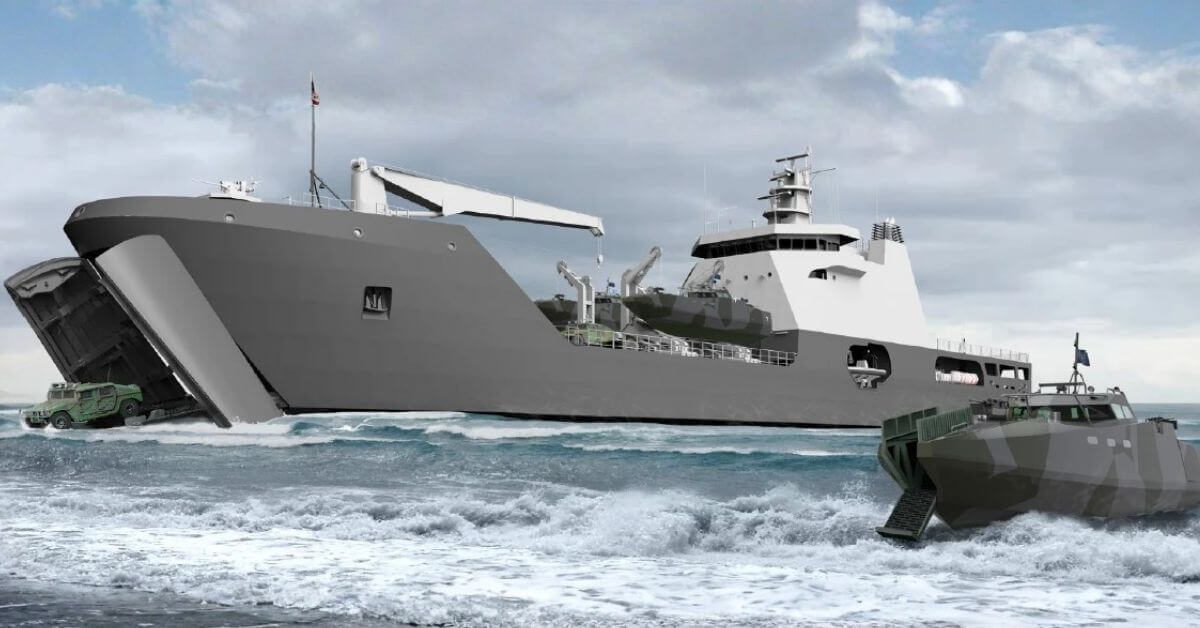
The U.S. Navy has reoriented its Landing Ship Medium (LSM) programme around the Dutch-built LST-100 design, aiming to accelerate production of the McClung-class vessels that will support Marine Corps littoral operations.
Naval Sea Systems Command (NAVSEA) confirmed that it paid Dutch shipbuilder Damen $3.3 million for the LST-100 technical data package, which will now form the basis of the service’s future landing ship fleet.
NAVSEA stated that selecting a mature, non-developmental platform would help shorten acquisition timelines and rapidly field the capability needed for Marine Littoral Regiments operating under the Marine Corps’ Force Design reforms.
The 4,000-ton LST-100 has a range of about 4,000 nautical miles and can carry roughly 250 embarked Marines, according to Damen’s specifications.
U.S. Secretary of the Navy John Phelan, speaking at the Reagan National Defense Forum, said the Navy chose the LST-100 because it is a proven design requiring few, if any, modifications.
He stated that all design requirements will be set before construction begins and added that any change requests during the build phase would be routed directly to him. He said he has set aside a weekly time slot to review any change requests, showing that the Navy intends to keep tight control over the design process.
The Navy is also preparing to acquire the ships under a Vessel Construction Manager (VCM) framework. Under this model, a contracted VCM will hold the design package and select one or more shipyards to construct the vessels.
Phelan mentioned in a recent video announcement that the Navy may use more than one shipyard to build the LSMs. The service plans to buy between 18 and 35 ships to support littoral operations.
The VCM approach has previously been used by the U.S. Maritime Administration, which appointed TOTE Services of Jacksonville, Florida, to manage construction of the five National Security Multi-Mission Vessels. TOTE oversaw the programme and contracted the builds to what is now Hanwha Philly Shipyard.
The Navy still needs approval from Congress before it can use the VCM approach. The draft Fiscal Year 2026 National Defense Authorization Act includes permission for the Navy to use a VCM for the first eight McClung-class ships, as well as for planned light replenishment oilers and other auxiliary vessels. This must become law before the Navy can move forward.
Despite the decision to adopt the LST-100, Gulf Coast-based Bollinger Shipyards is still expected to construct the first vessel, the future USS McClung (LSM-1).
In September, the Navy awarded Bollinger $9.5 million in advanced procurement funding for an LSM based on the Israeli Logistics Support Vessel, which is derived from the U.S. Army’s Frank S. Besson-class 4,200-ton landing ship. With the updated plan, the first LSM will now follow the LST-100 design.
Reference: USNI News
Source: Maritime Shipping News