
NTSB Releases Final Report Into Container Ship Collision That Brought Down Baltimore’s Key Bridge

Iran Seizes Oil Tanker Carrying 6,000,000 Litres Of Diesel With 18 Crew Onboard In Gulf of Oman
December 13, 2025
Google To Build 3 Subsea Cables In Papua New Guinea Under Australia-Backed Defence Pact
December 15, 2025
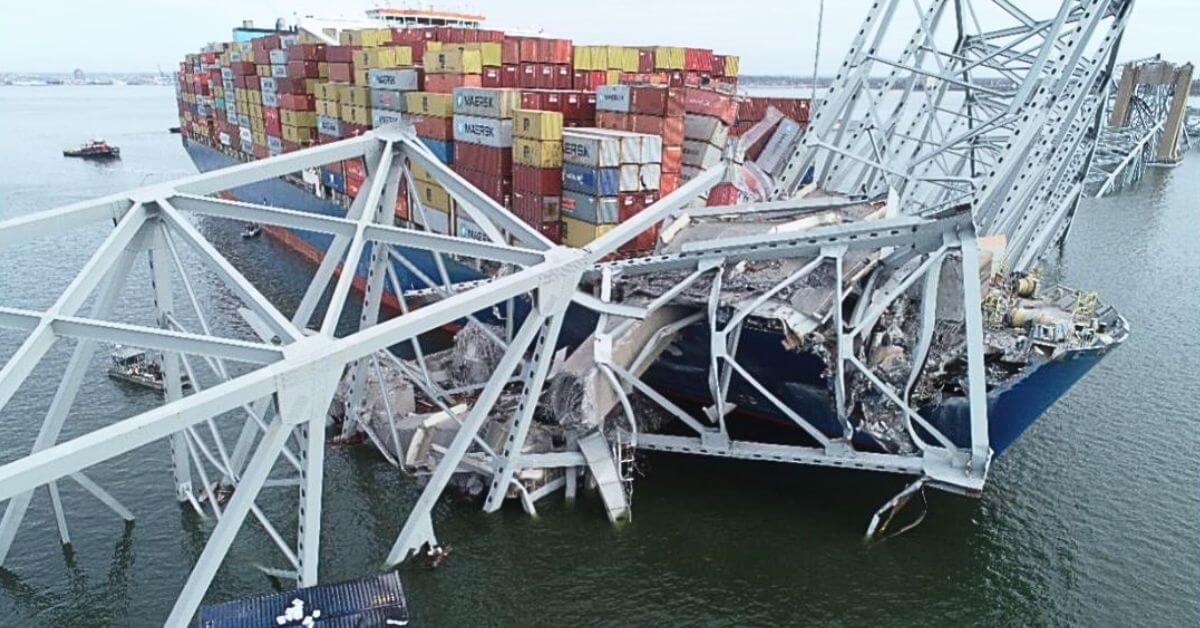
The final investigation report has concluded that a loss of electrical power on board the Singapore-flagged containership Dali caused the vessel to lose propulsion and steering before it struck the Francis Scott Key Bridge in Baltimore.
The accident occurred at about 1:29 a.m. local time on March 26, 2024, as the 984-foot-long containership was departing Baltimore Harbor. While transiting beneath the bridge, the vessel experienced a blackout that disabled its electrical systems, leading to a complete loss of propulsion and steering.
With the ship already close to the bridge, the crew had limited time to restore power before the vessel struck Pier 17, the southern pier supporting the bridge’s central span.
Following the impact, a substantial portion of the Francis Scott Key Bridge collapsed into the river. Sections of the pier, roadway deck, and steel truss spans fell onto the ship’s bow and forward container bays.
At the time of the collision, a seven-person road maintenance crew and one inspector were working on the bridge. Six of the highway workers died as a result of the collapse.
One worker survived with serious injuries, while the inspector escaped without injury. On board the Dali, one of the 23 people on board sustained a minor injury.
The final report stated that damage to the containership exceeded $18 million, while cargo damage had not yet been determined. Replacement costs for the bridge were also unavailable at the time of reporting.
The collapse has had significant consequences for transport in the Baltimore region. More than 34,000 vehicles used the Key Bridge daily, including a high proportion of heavy trucks. Traffic has since been diverted around and through the Port of Baltimore, increasing congestion and travel times.
The bridge had also served as the main route for vehicles carrying hazardous materials, which are prohibited from using the city’s underwater tunnels and must now take longer detours.
Investigators determined that the probable cause of the collision was a loss of electrical power caused by a loose signal wire connection.
Video Credits: First Coast News/YouTube
The report explained that the connection issue resulted from improper installation of wire-label banding, which prevented the wire from being fully inserted into a terminal block. This led directly to the blackout and the vessel’s subsequent loss of propulsion and steering.
The findings also noted that the crew’s ability to recover propulsion was limited by the vessel’s close proximity to the bridge at the time of the power failure, leaving insufficient time to regain control.
According to the final report, the collapse of the bridge and the resulting loss of life were worsened by the absence of protective countermeasures designed to reduce the risk of collapse following an impact by an ocean-going vessel.
The report further found that the lack of effective and immediate communication to alert highway workers to evacuate the bridge contributed to the number of fatalities.
As a result of the investigation, multiple safety recommendations were issued, including four urgent recommendations. Federal agencies were urged to form an interdisciplinary team involving the Federal Highway Administration, the US Coast Guard, and the US Army Corps of Engineers to help bridge owners evaluate and reduce the risk of vessel-related bridge collapses.
Bridge authorities across the United States were instructed to calculate the annual probability of collapse for specific bridges using the AASHTO Method II and to inform investigators if the calculated risk exceeded established thresholds. Authorities were advised to develop and implement comprehensive short- and long-term risk-reduction plans.
Read the full report
Reference: NTSB
Source: Maritime Shipping News