
Hapag-Lloyd Signs $500M Contract With Chinese Yard For 8 New Container Ships

Grounded MSC Baltic III Hull Severely Damaged After Winter Storms Off Newfoundland
December 15, 2025
15 Small Craft Approach Commercial Vessel Off Yemen, Exchange Of Fire Reported
December 16, 2025
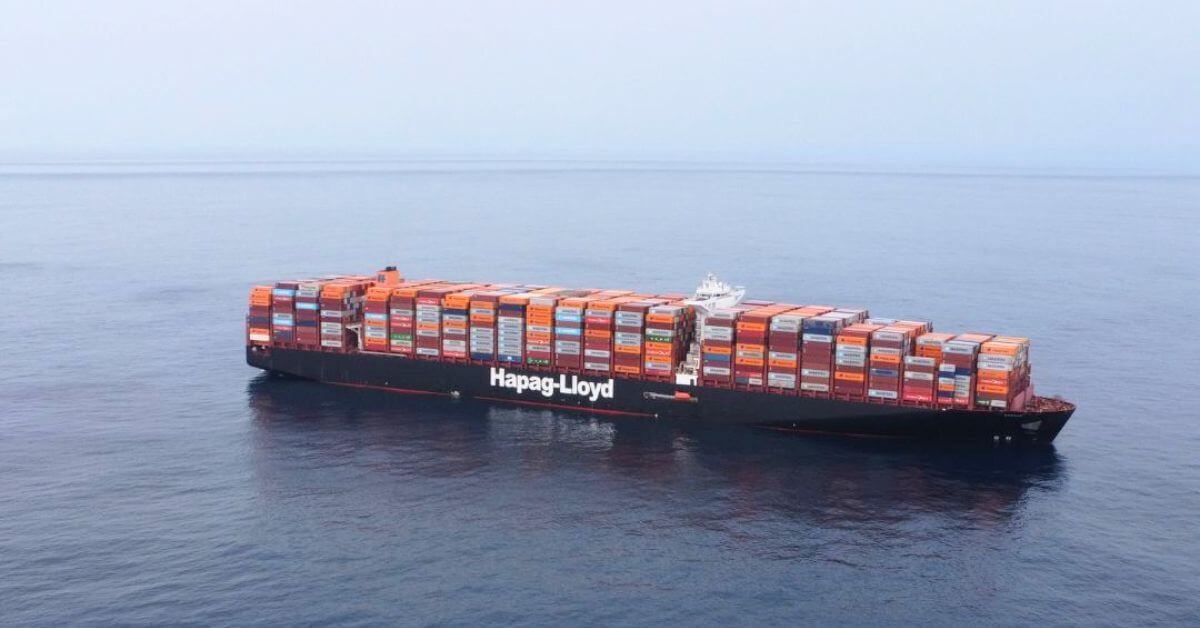
Hapag-Lloyd has ordered eight new dual-fuel methanol container ships from Chinese shipbuilder CIMC Raffles. Each vessel will have a capacity of 4,500 TEU, with deliveries scheduled for 2028 and 2029. The total value of the order is more than USD 500 million.
The new ships will be fitted with modern dual-fuel engines that can run on methanol. Hapag-Lloyd has said the vessels will be up to 30 per cent more efficient than older ships of the same size.
When operating on methanol, they are expected to cut emissions by up to 350,000 metric tonnes of CO2 equivalent per year. This is Hapag-Lloyd’s first newbuild project using methanol propulsion. The vessels will add to the company’s growing dual-fuel fleet.
At present, Hapag-Lloyd has 37 dual-fuel LNG container ships either in service or planned, and these ships can also operate on biomethane.
The methanol order follows earlier moves by the carrier. In April 2024, Hapag-Lloyd agreed with Seaspan Corporation to convert five 10,100 TEU container ships to dual-fuel methanol propulsion.
These conversions are planned for 2026 and 2027. In November 2024, the company also signed an agreement with Chinese energy producer Goldwind to secure 250,000 metric tonnes of green methanol per year.
The fuel will be a mix of biomethanol and e-methanol and is expected to reduce greenhouse gas emissions by at least 70 per cent while meeting current sustainability certification requirements.
Alongside the newbuilds, Hapag-Lloyd has decided to charter 14 additional container ships on a long-term basis. This includes four ships of 1,800 TEU, six ships of 3,500 TEU and four ships of 4,500 TEU.
These vessels are due to be delivered between 2027 and 2029. As announced earlier on 13 November 2025, the company is investing in a total of 22 vessels in the under-5,000 TEU segment.
Hapag-Lloyd’s chief executive Rolf Habben Jansen said fleet modernisation is a key part of the company’s Strategy 2030. He explained that the new ships will replace older vessels, help cut emissions, reduce dependence on chartered ships and lower operating costs by using more efficient tonnage.
Reference: Hapag Lloyd
Source: Maritime Shipping News