

China Converts Civilian Cargo Ship Into Missile-Capable Arsenal Vessel

Weathernews Launches World’s First Conversational AI Platform For Ship Captains
December 27, 2025
Russian Drone Attacks Damage Foreign-Flagged Vessels At Ukrainian Ports
December 27, 2025
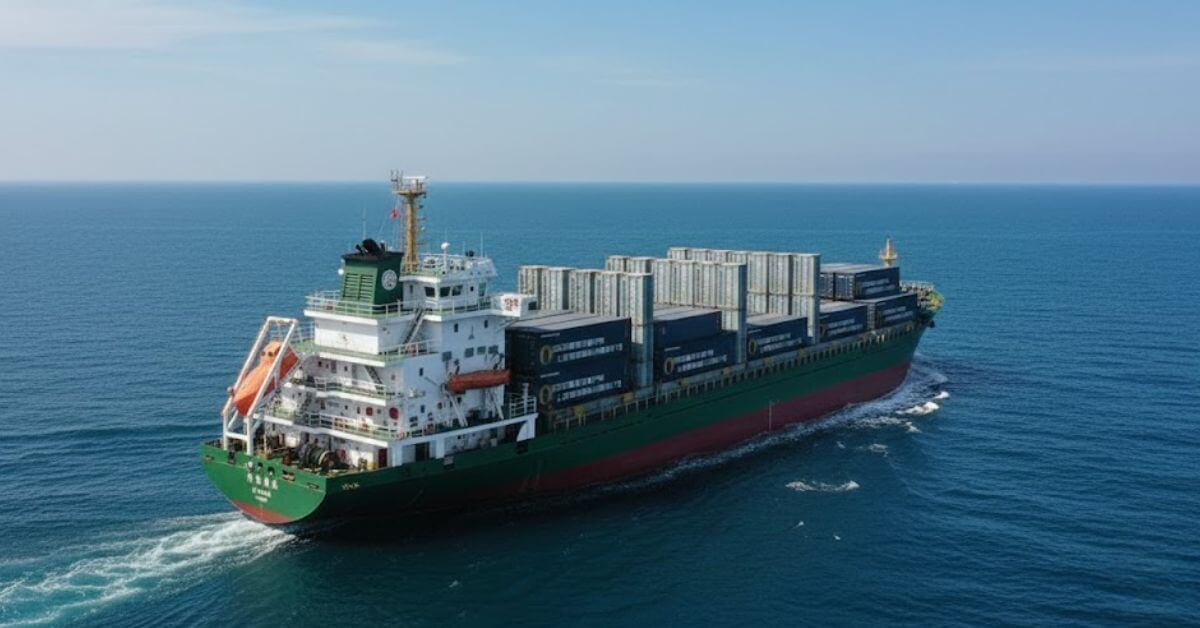
China appears to be converting civilian container ships into missile-capable military platforms using containerised weapons systems, according to images and analysis circulating online.
The photographs show a commercial cargo vessel fitted with missile launchers, radar systems and defensive weapons, suggesting the ship could be rapidly used for combat or support roles if required.
The images are reported to have been taken at the state-owned Hudong-Zhonghua Shipbuilding yard in Shanghai. They show a standard container feeder ship carrying container-shaped modules that resemble military equipment rather than commercial cargo.
The systems appear to be modular and removable, meaning the ship could be converted from civilian use to a military role and potentially returned to commercial service later.
Analysis of the images indicates that the ship is fitted with multiple containerised vertical launch systems mounted on its deck.
Observers report at least 48 vertical launch cells arranged in three rows of 16 cells, with each container believed to hold four launch cells. Other assessments suggest the total missile capacity could be as high as 60.
By using standard shipping containers, the launch systems can be installed with minimal changes to the vessel and handled using normal port equipment.
The ship is also fitted with defensive systems normally found on warships. These include a 30-mm Type-1130 close-in weapon system designed to defend against incoming missiles and aircraft.
At least three decoy launcher systems are visible near the bow, with analysts suggesting there may be additional launchers on the opposite side.
Several radar and sensor systems have been identified. A Type-344 fire-control radar can be seen, which is commonly used by the People’s Liberation Army Navy to guide naval guns.
A second flat-faced radar, believed to be an active electronically scanned array, is mounted nearby and may provide air-search or missile-guidance capability.
Additional sensors appear to be housed inside container units positioned between the bridge and the stern.
The exact missile types carried by the containerised launch systems have not been confirmed. However, analysts suggest the launchers could be capable of firing a range of Chinese missiles.
These may include the CJ-10 land-attack cruise missile, the YJ-18 series of anti-ship and land-attack cruise missiles, and potentially the YJ-21 anti-ship ballistic missile.
Further reporting identifies the ship as ZHONG DA 79, a 97-metre commercial container feeder vessel. Images show the ship fitted with containerised missile launchers, radar systems, decoy launchers and a close-in weapon system, leading analysts to describe it as a real-world example of the “arsenal ship” concept.
The vessel is reported to have stopped regular domestic operations some time ago and underwent refitting at a shipyard in Longhai earlier this year. Since August, it has been docked in Shanghai, where the final stage of its conversion is believed to have taken place.
Despite the visible weaponry, ZHONG DA 79 is not listed as part of the People’s Liberation Army Navy or its auxiliary fleet and appears to retain civilian status.
China has previously used similar hybrid approaches through the People’s Armed Forces Maritime Militia, where civilian fishing vessels have been involved in activities supporting state objectives in disputed maritime areas.
The use of containerised weapons is not unique to China. Russia has developed the Club-K containerised missile system, while the United States has tested container-based launchers such as Lockheed Martin’s MK-70 Mod 1, capable of firing Tomahawk cruise missiles and Standard Missile variants.
The US Army has also developed container systems capable of launching HIMARS rocket pods and tactical missiles.
Analysts say that converting commercial ships into missile-capable platforms could allow China to expand its naval firepower quickly without building additional warships.
Such vessels could also make it harder for adversaries to identify military threats, as civilian-looking ships may carry significant weapons.
References: interestingengineering, navalnews
Source: Maritime Shipping News