

China Overtakes Russia & Becomes World’s 2nd Biggest Operator of Nuclear Submarines

Pearl Harbor To House U.S Navy’s First Hypersonic-Armed Fleet By 2030
January 16, 2026
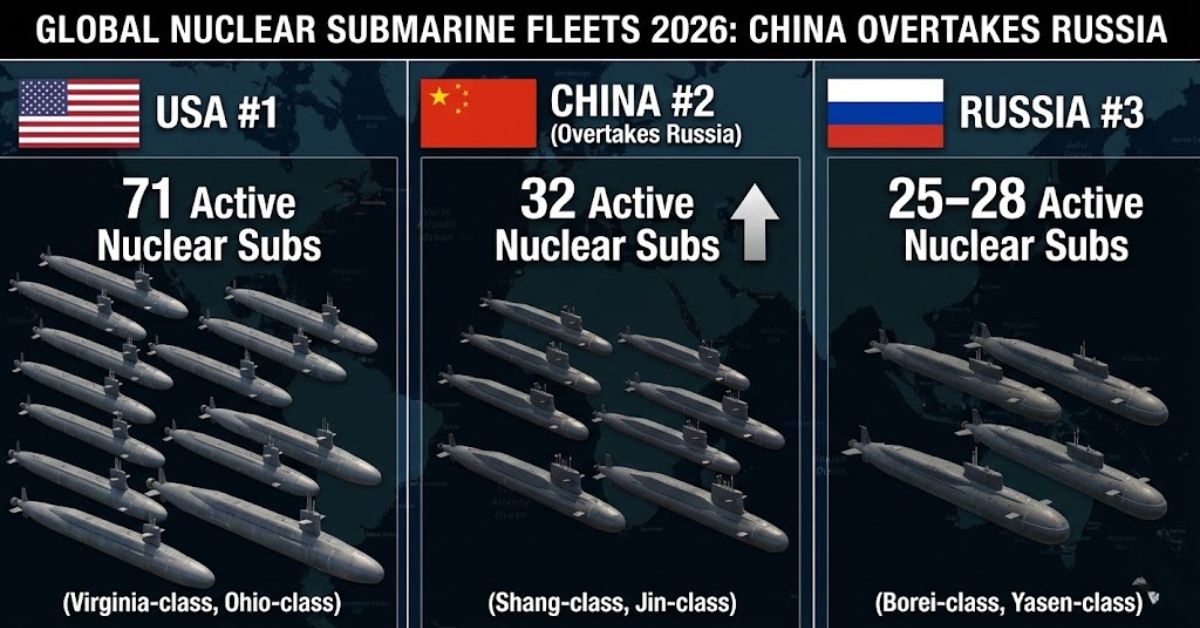
China is now the world’s second-largest operator of nuclear-powered submarines.
According to reports, China has 32 active nuclear submarines, while Russia has 25 to 28 operational ones.
The U.S. remains the number one, with the world’s biggest nuclear submarine fleet, operating 71 as of 31 December 2025, including fast-attack subs, ballistic missile subs and guided missile submarines.
China is building submarines and other warships at a tremendous pace and increasing its presence and dominance in the Indo-Pacific region.
China’s submarine fleet includes attacks variant, guided-missile subs and ballistic submarines; a maturing undersea fleet.
There are nine Type 093 and 093A Shang-class nuclear-powered attack submarines, which are the backbone of the submarine fleet, as they handle multi-mission assets.
China also has the Type 093B guided-missile submarine with vertical launch systems to fire cruise missiles.
About 16 Type 093B hulls exist, and many are in service while others are being constructed or undergoing trials.
This is the biggest series of nuclear submarines presently being constructed anywhere in the world.
China’s nuclear deterrent at sea is anchored by the nine Type 094 and 094A Jin-class ballistic missile submarines, equipped with JL-2 and the newer JL-3 submarine-launched ballistic missiles.
China is also working on two submarine programs. A Type 095 nuclear attack sub is being assembled, and the first Type 096 ballistic missile sub is reported to be under construction.
These next-gen designs are expected to improve stealth, range and survivability.
This brings China’s active nuclear submarine fleet to 32 boats in 2026, excluding the next-gen hulls still being constructed.
Russia is now in third place in terms of the number of active hulls. It has Borei-class ballistic missile submarines, Yasen and Yasen-M guided-missile submarines, along with older platforms.
Though the U.S Navy remains ahead in terms of numbers, it has a slow production line.
The USS Lowa was commissioned in April 2025, followed by USS Massachusetts and USS Idaho later that year, both to be commissioned in 2026.
US production has struggled to maintain a steady pace due to workforce shortages and logistical challenges.
On the other hand, China is constructing many hulls simultaneously and might even overtake the U.S. if the trend continues.
Beijing has plans to expand its fleet through the 2030s and overtake the U.S. by 2035.
This has alarmed Washington as Beijing is focusing on deploying these assets within strategic and volatile zones like the South China Sea to increase its maritime presence.
The U.S is focusing on forward presence and anti-submarine operations across the Indo-Pacific.
The AUKUS partnership is a major pillar of this approach.
The U.S. and the UK are deploying their nuclear subs in Australia on a rotational basis to keep China in check.
Source: Maritime Shipping News