

USCG’s Only Heavy Icebreaker ‘Polar Star’ Completes 50 Years Of Service

China Tracks U.S. Warships During Taiwan Strait Transit, Keeps Forces On High Alert
January 19, 2026
EU Simplifies Ship Recycling Compliance With New Standard Certificate Formats
January 20, 2026
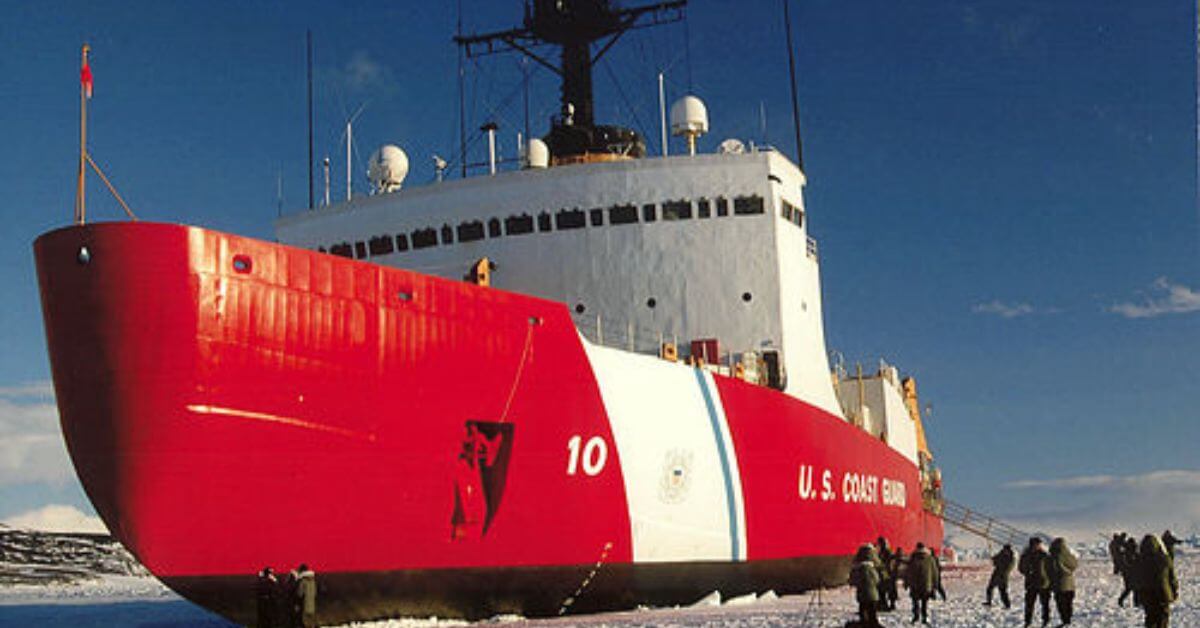
The U.S. Coast Guard’s heavy icebreaker Polar Star has completed 50 years in service, marking the milestone while carrying out its annual Antarctic mission.
The vessel arrived at McMurdo Sound this month as part of Operation Deep Freeze, where it clears ice to allow supply ships to reach scientific research stations in Antarctica.
The Polar Star, the Coast Guard’s only heavy icebreaker, is capable of cutting through ice up to six feet thick at a speed of three knots.
According to the Coast Guard, the vessel can also break ice as thick as 21 feet by repeatedly ramming, reversing, and ramming again when conditions require it.
The 13,500-ton ship, commissioned on 17 January 1976, is now among only three fully operational U.S. military vessels that are more than half a century old.
The other two vessels are the USS Blue Ridge, commissioned in November 1970, and the USS Nimitz, commissioned in April 1975.
The Polar Star departed its home port at Coast Guard Base Seattle on 20 November for the current deployment.
Ahead of the journey, the ship’s commanding officer, Captain Jeff Rasnake, indicated that the crew hoped to mark the ship’s anniversary near Cape Polar Star.
The cape, named after the vessel in the 1980s, is located on the southwestern tip of Coulman Island in Antarctica’s Ross Sea. He described the ship as ageing but dependable.
The Polar Star is one of only three oceangoing icebreakers operated by the U.S. government.
In addition to the Polar Star, the Coast Guard operates two medium icebreakers, the USCGC Healy and the USCGC Storis, both of which can break ice up to eight feet thick using the ramming method.
The Coast Guard commissioned two heavy icebreakers in the 1970s: the Polar Star in 1976 and its sister ship, the Polar Sea, in 1978.
The Polar Sea was retired in 2010 due to severe engine wear, leaving the Polar Star as the only heavy icebreaker currently in active service.
The Polar Star’s official motto is “Naviget Bene Turbatum Mare”, which translates to “May she sail well through turbulent seas.”
Reference: stars and stripes
Source: Maritime Shipping News