
U.S Navy’s Newest Combat Ship With One Of The Largest Flight Decks Commissioned

U.S Navy’s New Submarine Named After Famous WWII Battleship
January 23, 2026
U.S Navy Fires One-Way Attack Drone From Warship At Sea For The First Time
January 23, 2026
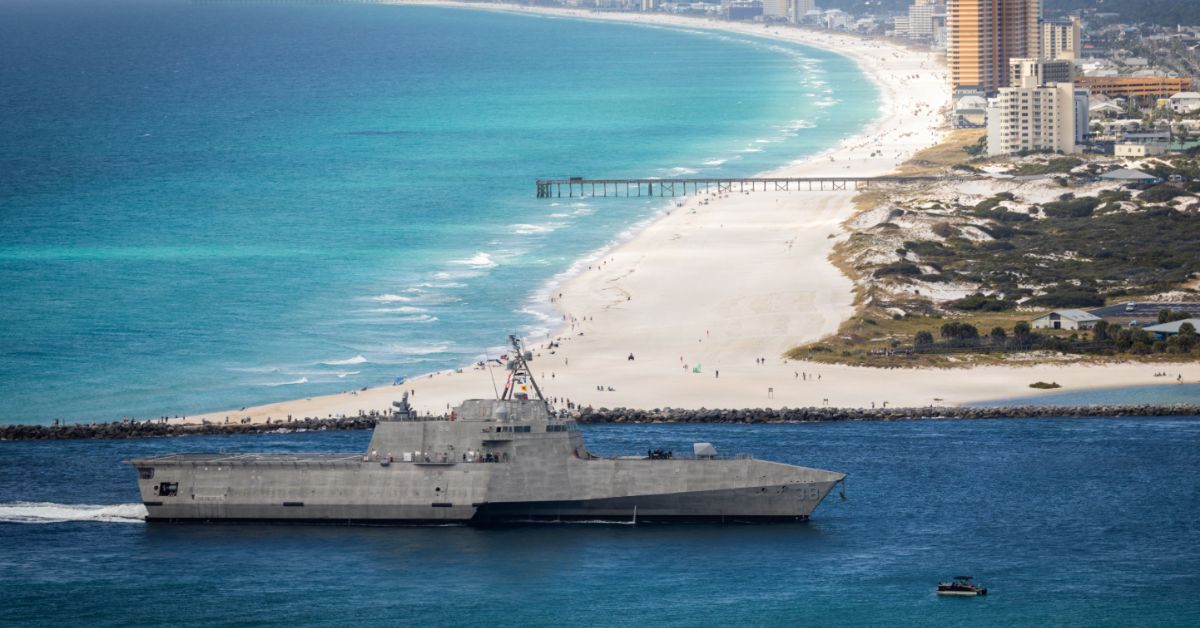
USS Pierre was commissioned into the U.S Navy as the 19th and the last Independence-class littoral combat ship, in a ceremony held at Naval Support Activity Panama City.
This marks the end of a 20-year program which has led to the delivery of the Navy’s fastest and most adaptable surface ships.
It was constructed by Austal USA in Alabama, and is the second vessel to carry the South Dakota capital’s name, the first being a WWII era submarine chaser.
The ship has a displacement of 3000 metric tons and is 418 feet long and 104 feet wide. It is propelled by a diesel and gas turbine power system, which drives waterjets.
The USS Pierre has San Diego as its home port.
It can tackle multi-domain threats in open waters and also near the shores, while sailing at speeds of over 40 knots.
It has a 4300 nm range at cruising speed and a great endurance and rapid manoeuvrability, a main feature of the Independence-class ships.
Coming to the design, it features a trimaran one and is built of lightweight aluminium.
Its three-hull configuration reduces drag and makes it more stable while sailing at high speeds, all while maintaining a shallow draft of less than 14 feet, for missions near shore.
The wide beam allows it to have one of the biggest flight decks of any US surface combatant.
Its mission bay can embark a range of systems, including rigid-hull inflatable boats, unmanned surface vessels, and unmanned underwater vehicles. It can also support MH-60 helicopters and unmanned aerial systems.
The ship has a crew of 40 and advanced combat systems like the SeaRAM missile defence system, a 57 mm Mk 110 deck gun, and a combat suite to integrate air, surface, and subsurface data.
Its command centre can connect with aircraft, unmanned systems, joint forces, and allied naval units and share real-time targeting and situational awareness information.
The Independence class has been used for mine countermeasures testing, surface warfare training, maritime interdiction operations, etc.
Source: Maritime Shipping News