

Japan Escalates Maritime Deterrence With Agile New Ship-Killer Missile

Russian Tanker Carrying 730,000 Barrels Of Oil Drifts Out Of Control In Mediterranean
January 24, 2026
US Sanctions 9 Tankers Carrying Iranian Oil Amid Nationwide Protests & Internet Shutdown
January 24, 2026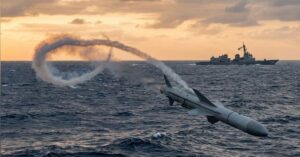
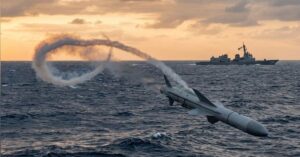

Japan’s Acquisition Technology & Logistics Agency (ATLA) has revealed video of its New Surface-To-Ship Missile (New SSM) performing high-G terminal manoeuvres.
The video has gained a lot of traction across defence and maritime communities, and confirms that Tokyo’s new “Island Defence Missile” can do deliberate barrel rolls during its terminal phase.
This “corkscrew” trajectory was especially built to handle shipborne air defence systems by confusing the fire-control radars and interceptor algorithms in the final seconds before impact.
This also highlights a shift in Japanese naval doctrine from pure containment to active, high-survivability deterrence.
By continuously changing its flight path, the SSM negates the predictive plotting required by close-in weapon systems (CIWS) and advanced surface-to-air missiles.
The missile operates at subsonic speeds, which makes it almost impossible for other weapons to strike it compared to other linear-tracking anti-ship missiles.
Kawasaki Heavy Industries (KHI) is the prime contractor of the programme.
The missile is powered by the XKJ301-1 turbofan, a derivative of KHI’s fuel-efficient KJ300 engine.
The two-spool turbofan design allows the missile to strike from “standoff” distances well beyond the horizon.
Officials confirm the weapon significantly outranges the incumbent Type 12 missile (approx. 200 km range), allowing the Japan Maritime Self-Defence Force (JMSDF) to engage hostile combatants without exposing their own batteries to counterfire.
Industry analysts suggest the New SSM is not merely a standalone weapon but the genesis of a modular family.
This could allow the JMSDF to swap payloads or propulsion units, potentially leading to
Supersonic Dash Variants for time-critical targets, Air-Launched Configurations for deployment by maritime patrol aircraft and also AI-Driven Guidance.
The development of the New SSM began in 2023 and is a direct response to the increasing maritime traffic and militarisation in the East and South China Seas.
As China expands its maritime influence, especially its artificial islands, Japan has also remodelled its National Security Strategy to secure remote territories, including the Senkaku Islands.
The missile is likely to be deployed in the mid 2020s on both the navy’s destroyers and also mobile ground batteries across the Nansei Island Chain.
It could also be supplied to allies like Australia or the Philippines, which plan to strengthen their own coastal denial capabilities.
Source: Maritime Shipping News