
German Researchers Commence €390,000 Project To Reduce Cavitation Noise From Ships

Seaspan Invests $1.5M In Robotics To Automate Shipbuilding Blast & Paint Operations
February 19, 2026
Port Of Virginia Strengthens Safety Culture To Reduce Injuries And Lost Workdays
February 19, 2026
German researchers have launched a new project aimed at reducing underwater noise generated by ship propellers, a long-standing issue that affects marine life.
The initiative, known as MinKav, began on 1 January 2026 and is funded by the state of Schleswig-Holstein with a €390,000 grant.
The project is being led by the Institute for Shipbuilding and Maritime Technology at HAW Kiel.
The research team intends to develop new propeller designs that lower underwater noise levels without reducing vessel efficiency or speed.
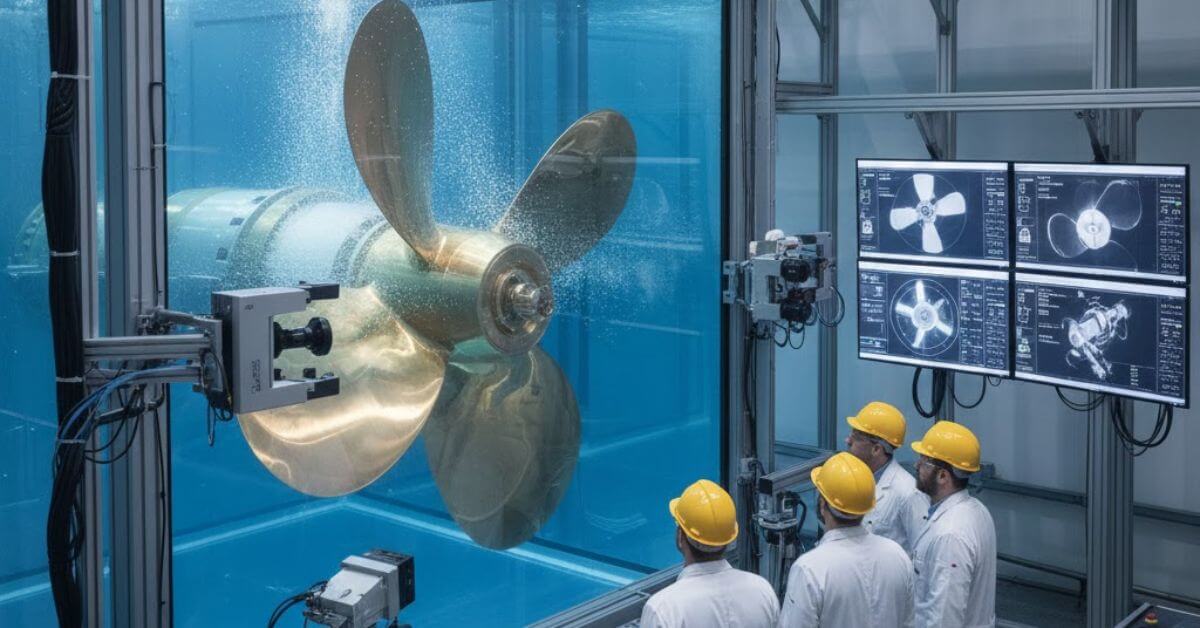
Propeller noise is primarily caused by cavitation, a physical process that occurs when pressure drops sharply on the suction side of a rotating blade. This pressure change causes water to vaporise and form small bubbles.
When the pressure increases again, the bubbles collapse forcefully, producing strong impulsive sounds that can travel long distances underwater. Such noise interferes with the communication, feeding and mating patterns of marine mammals.
Leonie Föhring is leading the doctoral research at HAW Kiel. She is using a cavitation tunnel, high-speed cameras and underwater microphones to analyse how cavitation bubbles form and collapse.
According to her explanation, the loudest sound is generated at the moment the bubble collapses, and its intensity depends on how quickly the process occurs.
Her research aims to determine whether slowing the collapse could reduce noise and how propeller designs might be adapted to achieve this.
Professor Jörn Kröger, who leads the project, has stated that underwater noise has not traditionally been a primary consideration in commercial propeller design.
He believes that practical methods are required so that noise reduction can become a standard part of propeller development, particularly in view of upcoming environmental limits. He has also stressed that any design changes must avoid significant losses in efficiency or speed.
At present, some noise reduction measures require vessels to operate at lower speeds, which can extend voyage times and increase costs for shipping companies.
The MinKav team is using computer-based flow simulations to explore alternatives that would allow ships to remain energy efficient while reducing acoustic impact.
The project also involves JASCO-ShipConsult, a company specialising in ship acoustics.
Dr Dietrich Wittekind, a shipbuilding engineer with the firm, has stated that although low-frequency underwater noise has been studied internationally for two decades, there is still insufficient understanding of the mechanisms responsible for high noise levels.
He has said that this lack of fundamental knowledge limits efforts to make ships quieter and that MinKav seeks to systematically examine the root causes and develop concrete solutions through propeller modifications.
The researchers expect that the results could be applied to both newly built ships and existing vessels. If successful, the project could contribute to reducing underwater noise pollution across global shipping fleets.
Reference: interestingengineering
Source: Maritime Shipping News