
UK Transfers Decommissioned Survey Ship To Bangladesh Navy In Strategic Defence Agreement

Italian Courts Order €76,000 Compensation To Sea-Watch And Release Of Detained Vessel
February 21, 2026
Fire Erupts In Cargo Hold Of 656-Foot Break-Bulk Carrier At Port Of Vancouver
February 21, 2026
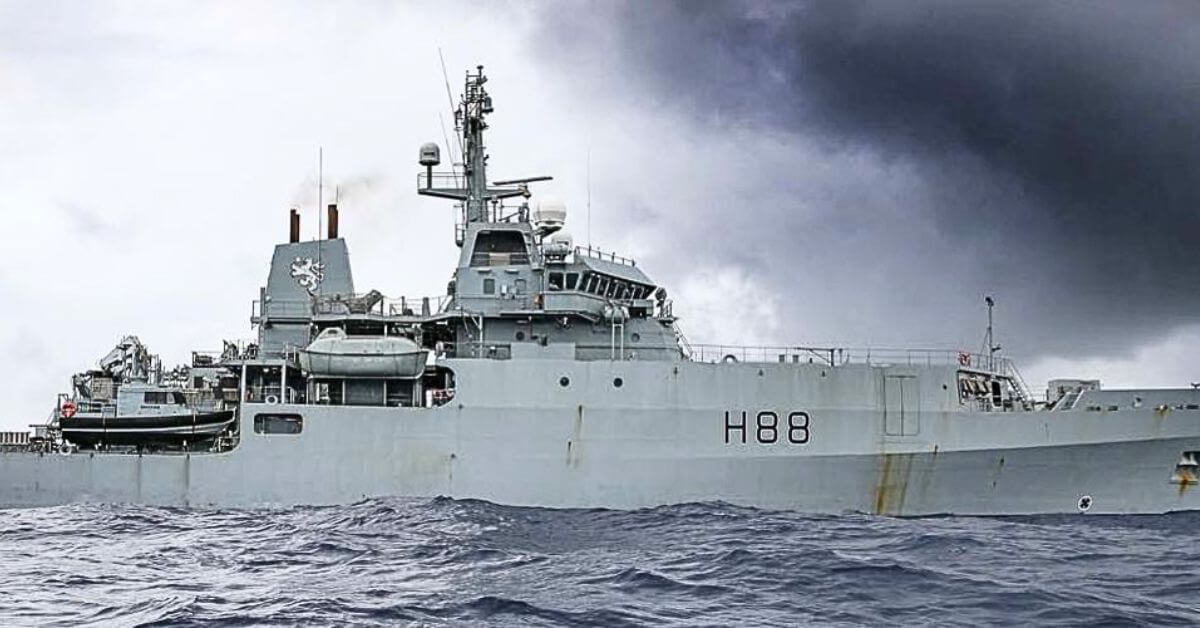
The United Kingdom has signed a government-to-government defence sales agreement to transfer the former Royal Navy hydrographic survey vessel HMS Enterprise (H88) to the Bangladesh Navy.
The agreement was concluded on 8 February 2026 in Dhaka.
The vessel, decommissioned in March 2023, will strengthen Bangladesh’s hydrographic, oceanographic and maritime security capabilities in the Bay of Bengal.
The sale extends the service life of a specialist survey ship while supporting maritime cooperation between the two countries.
The agreement followed technical engagement between the Bangladesh Navy, the UK Ministry of Defence and the Royal Navy.
The ship had been laid up at Portsmouth Naval Base since 30 March 2023. The sale generates a modest but undisclosed payment for the Royal Navy.
British High Commissioner to Bangladesh Sarah Cooke stated in third-person remarks that the transfer reflected strong cooperation between the United Kingdom and Bangladesh.
HMS Enterprise was the second of two Echo-class multi-role hydrographic and oceanographic survey vessels, alongside HMS Echo (H87).
She was launched on 27 April 2002 and commissioned on 17 October 2003. Her home port was HMNB Devonport in Plymouth.
The ship displaced 3,740 tonnes. She measured 90.6 metres in length, with a beam of 16.8 metres and a draught of 5.5 metres.
Propulsion was diesel-electric. Three diesel generators produced 4.8 MW of power, driving two 1.7 MW azimuth thrusters and a 0.4 MW bow thruster.
The configuration allowed 360-degree manoeuvrability and precise station-keeping. The vessel had a maximum speed of 15 knots, a range of 9,300 nautical miles at 12 knots, and an endurance of 35 days.
The Echo-class ships were the first Royal Navy vessels fitted with azimuth thrusters in a diesel-electric configuration.
They were developed in the mid-1990s to replace older survey ships including HMS Bulldog, HMS Beagle and HMS Roebuck.
The Ministry of Defence confirmed the £130 million programme in June 2000, including 25 years of through-life support.
Vosper Thornycroft acted as prime contractor, with construction carried out by Appledore Shipbuilders in North Devon.
During more than 20 years of service, HMS Enterprise surveyed hundreds of thousands of square miles of seabed. She steamed over 500,000 miles.
In 2022, the vessel sailed within 1,000 miles of the North Pole, the closest any Royal Navy vessel had reached. She also supported humanitarian operations, including assistance following the Beirut port explosion in August 2020.
The Royal Navy decommissioned the ship in March 2023, ahead of her planned out-of-service date of 2028.
The decision was linked to cost pressures, maintenance demands and the expansion of autonomous survey methods under the Navy’s Future Military Data Gathering Programme.
The Bay of Bengal is central to Bangladesh’s maritime economy. According to the U.S.-based East-West Center think tank, the region supports 90 per cent of Bangladesh’s trade and 100 per cent of its energy transportation.
The waterway faces security risks including piracy, armed robbery, trafficking and illegal, unreported and unregulated fishing.
The addition of a dedicated hydrographic survey vessel enhances Bangladesh’s ability to conduct seabed mapping, support safe navigation, manage maritime boundaries and respond to disasters.
The platform also provides research opportunities for national universities.
Bangladesh has previously integrated former Royal Navy vessels, including BNS Anushandhan, formerly HMS Roebuck, into its fleet for hydrographic duties.
References: Armyrecognition, Naval today
Source: Maritime Shipping News